


Welcome and Prayer: Nancy Lopez
Welcome friends! Grace and Peace to you!
This past week I had a little cold. I say little because I was really only sick for a few days. There was something going around where we live; my friend said it lasted seven days for her, and she said, “Your immune system is probably better than mine.” That got me thinking about immunity in a broader sense. We know that a healthy immune response is developed when we’ve been exposed to something and get through it. I’m wondering if that correlates with our faith.
If we have experienced doubt, disappointment, or confusion, for instance, could navigating through that build our faith so we don’t have a such a heightened allergic—”all-hands-on-deck”–reaction next time around? I don’t think, then, that it’s necessarily a bad thing if we’re exposed to something hard, if it causes our faith in God to grow. I know that I, for instance, used to be very reactive to disapproval; but I know that someone else can’t tell me who I am. Our bodies recognize an invader, something that doesn’t belong; and I think our souls do too. When we are allergic, we overreact. When we’re immune, the invader is fought off mostly without our awareness of it. Our relationship with God may include being broken, disheartened—and, well, sometimes miserable. How could these help to enlarge our capacity and build our immunity to foreign invaders of our souls?
Remember what James said, “Dear brothers and sisters, when troubles come your way, consider it an opportunity for great joy. For you know that when your faith is tested, your endurance has a chance to grow. So let it grow, for when your endurance is fully developed, you will be perfect and complete, needing nothing.”
So, here’s your wellness tip from Nurse Nancy today. Drink lots of water, create space for silence, and if you’re exposed to something unpleasant, maybe you’re just building your immunity to critics, naysayers, and fearmongers.
Let’s pray: Lord, we confess that we are prone to fleeing, fighting, or some other form of over-reaction. Let it be that we walk through everything with you, so that you can mature us and form us into people of the Way. When we repent, will you forgive us. When we train, will you build us up. What seems bitter–make it as sweet as honey to us. Grant us to be strengthened in you, that the mystery of our own souls would be fulfilled, and that we would confidently stand before many in your name. Amen
Morning Talk: chuck smith, jr.
Then I saw another mighty angel coming down from heaven, wrapped in a cloud, with a rainbow over his head, and his face was like the sun, and his legs like pillars of fire. He had a little scroll open in his hand. And he set his right foot on the sea, and his left foot on the land, and called out with a loud voice, like a lion roaring. When he called out, the seven thunders sounded. And when the seven thunders had sounded, I was about to write, but I heard a voice from heaven saying, “Seal up what the seven thunders have said, and do not write it down.” And the angel whom I saw standing on the sea and on the land raised his right hand to heaven and swore by him who lives forever and ever, who created heaven and what is in it, the earth and what is in it, and the sea and what is in it, that there would be no more delay, but that in the days of the trumpet call to be sounded by the seventh angel, the mystery of God would be fulfilled, just as he announced to his servants the prophets. Revelation 10:1-7
Intro: I get the feeling that when we read the book of Revelation,
We tend to watch each scene unfold from a safe distance
– I don’t think it was meant to read this way,
• we’re supposed to feel a threatening closeness
• we’re drawn into the dream – it’s our collective nightmare
– John was certainly more than a spectator
• characters approach him, converse with, and engage him
◦ in this chapter he’ll be told to take and eat what he has been shown
• we do not merely read the Revelation, we encounter it
◦ we go on an adventure through this fantastical other-world
Initially, there was the scroll with the seven seals
– after the sixth was opened, there was a long break before the seventh seal was opened
• and what happened with the seventh seal was significantly different from first six
◦ so now, there are seven trumpets that sound, and another break between the sixth and seventh
(this break includes all of chapter ten through to chapter 11:15)
◦ again, there is significant difference in what happens when the seventh trumpet sounds
• each series of sevens seems to overlap – like newsreels of the same event, but from different angles
◦ what is happening is the reverse of the creation story
◦ this is the destruction of heaven and earth – the end of the world
– the seventh day of creation is different from the first six days
• the seventh day is holy and a day of rest
• that is the pattern of this section of Revelation (all way to chapter 16)
What happens during this break before the seventh trumpet?
I think it can best be expressed by a verse from Deuteronomy:
The secret things belong to the LORD our God, but the things that are revealed belong to us and to our children forever, that we may do all the words of this law (Deut. 29:29)
– here in Revelation 10, by a dramatic display, we will learn that God has secrets
– soon we are told his mystery will be “fulfilled”
• that God’s project through the millennia of human history will at last be seen and known as it comes about
The last scene of chapter 9 was that of a smoldering landscape
As the survivors were burying their dead, they persisted in doing wrong
– in John’s next vision, he sees a mighty angel descending to earth
• the impression John gives us of the angel’s appearance:
◦ is brilliant light – his face shines like the sun, even legs bright as fire
◦ and above his head, light is refracted into a rainbow of color
• John notices the angel has a scroll in his hand,
◦ that it is “little” and it is “open” (not like the previous scroll that was closed and sealed with 7 seals)
– the angel sets down with his right foot on the sea and his left foot on the earth
• in chapter 13, a satanic beast will rise out of the sea and another demonic beast will rise out of the land
• before that, here is this might angel whose feet on the sea and earth already indicates his dominance
◦ in the book of Joshua, after Israel’s first major conquest, five Canaanite kings were brought to Joshua
He summoned the leaders of the army and told them, “Come near; put your feet on the necks of these kings.” . . . And Joshua said to them, “Do not be afraid or dismayed; be strong and courageous. For thus the LORD will do to all your enemies against who you will fight” (Jos. 10:24-25)
◦ that is how I understand the angel’s stance on the sea and earth
What happens next I do not think is easy to understand
– when the angels speaks, his voice is the roar of a lion
• and then, either in response to his voice or as a loud echo, “the seven thunders sounded”
◦ I’m pretty sure that “seven” indicates full volume
• but when John was about to write what he heard the thunders say,
◦ he was told not to write it – which is unlike the little book that was already written on and open
– so why this build-up and all the fanfare, just to shut us out? Why even mention the seven thunders?
• my guess is that God wants to make it clear to us, there is far more to know than what we’ve been given
◦ if it what they said would have been helpful for us, then it would not be kept from us
Jacques Ellul, “For it must not be forgotten that the Word is revealed only to the extent that it is useful to [humans].”
◦ and St. Peter wrote,
His divine power has granted to us all things that pertain to life and godliness, through the knowledge of him who call us to his own glory and excellence (1 Pet. 1:3)
• some people have an unhealthy interest in the supernatural
◦ various cultures have devised occult means to pry into the unknown
◦ the Scriptures warn us away from all of that
there’s more darkness and deception in those practices than light and truth
John’s attention is drawn back to the angel
In swearing an oath, a person would raise their hand (Ps. 106:26, etc.)
– we still raise right hand today – as do presidents when they are inaugurated
• the angel’s sworn oath is that
there would be no more delay, but that in the days of the trumpet call to be sounded by the seventh angel, the mystery of God would be fulfilled
• God has been working out a plan since the beginning
◦ it has been hidden from us – that’s what mystery means; something hidden or secret
◦ mystery in the New Testament does not mean uncanny, or spooky, or a puzzle to solve
– previously, some mysteries had been revealed
• for instance, Paul’s insight regarding Jesus, which was
according to the revelation of the mystery that was kept secret for long ages but has now been disclosed and through the prophetic writings has been made known to all nations (Ro. 16:25-26)
. . . the mystery was made known to me by revelation, as I have written briefly. When you read this, you can perceive my insight into the mystery of Christ, which was not made known . . . in other generations as it has now been revealed to his holy apostles and prophets by the Spirit (Ep. 3:3-4)
• but here the mystery is not “revealed,” but “fulfilled”
◦ we will realize God’s plan as it unfolds in our world
The ongoing drama becomes even more personal for John
Then the voice that I had heard from heaven spoke to me again, saying, “Go, take the scroll that is open in the hand of the angel who is standing on the sea and on the land.” So I went to the angel and told him to give me the little scroll. And he said to me, “Take and eat it; it will make your stomach bitter, but in your mouth it will be sweet as honey.” And I took the little scroll from the hand of the angel and ate it. It was sweet as honey in my mouth, but when I had eaten it my stomach was made bitter. And I was told, “You must again prophesy about many peoples and nations and languages and kings.” Revelation 10:8-11
The same voice from heaven that told John not to write what the seven thunders said,
– now instructs him to go and grab the open scroll from angel
• when he does this, the angel tells him to take it and eat it
◦ consuming God’s word is a familiar metaphor
I have not departed from the commandment of his lips
I have treasured the words of his mouth more than my portion of food (Job 23:12)
Your words were found, and I ate them,
and your words became to me a joy and the delight of my heart (Jer. 15:16)
◦ Ezekiel was given similar instructions to those John received
“Eat this scroll, and go, speak to the house of Israel.” So I opened my mouth, and he gave me this scroll to eat. And he said to me, “Son of man, feed your belly with this scroll that I give you and fill your stomach with it” Then I ate it, and it was in my mouth as sweet as honey (Eze. 3:1-3)
– I dug up an old meditation from 1999, that I wrote on this verse
My med: “God’s word had to enter him, not as information feeding into his brain, but as a life force which his body assimilated so that it became a part of him and energized him. There is a great deal of Bible study going on, but too little meditation, too little ingesting of God’s word. We have lots of information, but not as much transformation.
Read the Bible, but also feed on it. Taste its sweetness. You savor bits of insight, the discovery of connections between texts, and word studies that reveal a variety of meanings. Let what you receive sit with you for awhile. Let it digest until it becomes a part of you, and then you must live it. That is when it turns bitter. That is the hard part of receiving God’s word. Bible study can be fun. Living the truth can be bitter. Giving God what his word requires of us can bring unwanted changes, deprive you of comforts, take you where you do not want to go, show you things you don’t want to see, and upset your entire world.”
• after eating the scroll, John is given a job to do (v. 11)
• and we’ll leave him there for now
Conclusion: A few weeks ago, Jim suggested a title for these talks
“A Document of Spiritual Direction”
– if so, what must we learn to continue our spiritual journey?
- We must accept the fact that there are doors we cannot open
I want a far more vivid awareness of God’s presence, something almost tangible
But God has not chosen that for me, and I can’t manufacture it
I’ve had to accept this closed door - On the other hand, we must make the most of the doors he has opened
- We must receive the Scriptures as our necessary spiritual diet
Be with what we read long enough to digest it, break it down, and draw nutrition from it - We must live it, do it, speak it when given the opportunity
Little children, let us not love in word or talk but in deed and truth (1 Jn. 3:18) - What is the message that has been given to you?
Write it down somewhere - How are you going to deliver it?
This is our homework – and it will keep us busy for a lifetime
Welcome and Prayer: Nancy Lopez
Good morning, RefleXion! Grace and Peace to you!
Jesus died and was resurrected, and he appeared to others for 40 days after that before he ascended to heaven. And we learn that he still had his scars. He shows them to his disciples to prove his identity, and his humanity.
Have you heard of Kintsugi, the Japanese art of embracing imperfection? It is the art of taking a shattered piece of pottery and mending every crack with gold, which creates a piece that is even more beautiful than the first by embracing the beauty of the flaw. A few weeks ago, on 60 Minutes—maybe you saw it—there was a story of a woman (her name is Jennifer Thompson) who brings together wrongly convicted prisoners and victims who have wrongly identified criminals. All these lives have been shattered. In these healing workshops, you know what she does? She gives them each a bowl and asks them to take a hammer and shatter it. This represents their shattered lives. Then she gives them gold lacquer and asks them to mend their bowl with gold. But before they can mend the cracks representing their wounds, they must look hard at the breaks that need repair, each one and how it connects to another. And that takes time. Exonerees had been freed and there is still much brokenness, just like us. Victims had seen justice, and they were shattered with shame and guilt as well as the original injury. Everyone was a victim; everyone had wounds.
The risen Christ has scars, being raised from the dead does not erase them. We have scars; becoming free from sin doesn’t mean we don’t still need healing. In 2 Corinthians, Paul says that he will boast of the things that show his weakness that the power of Christ may rest upon him. He said that he bore the marks of Jesus on his body. The gold veins of Jesus’ redeeming, restoring, and healing work in our lives represent our marks of Jesus’. Can we see it this way? Let his power be made perfect in our weakness. Will you join me to pray?
Jesus, you bought back our shattered lives. We have wounds, open and unhealed injuries. Thank you for your continued work in mending our lives. May each scar—a wound healed—be considered the gold that makes us human, and beautiful. May each scar represent the glory of resurrection. Be with us now as we gather in your name. Amen
Morning Talk: chuck smith, jr.
And the fifth angel blew his trumpet, and I saw a star fallen from heaven to earth, and he was given the key to the shaft of the bottomless pit, and from the shaft rose smoke like the smoke of a great furnace, and the sun and the air were darkened with the smoke from the shaft. Then from the smoke came locusts on the earth, and they were given power like the power of scorpions of the earth. They were told not to harm the grass of the earth or any green plant or tree, but only those people who do not have the seal of God on their foreheads. They were allowed to torment them for five months, but not to kill them, and their torment was the torment of a scorpion when it stings someone. And in those days people will seek death and will not find it. They will long to die, but death will flee from them Revelation 9:1-6
Intro: When my children were small, I’d read to them every night
First from a book of fairytales, then from a Bible storybook
– we would pray, say goodnight, and turn off the lights
• we were careful about the last thing that entered their minds before bed
• I doubt we can prevent our kids from having nightmares
◦ but we can do things to help them sleep well
◦ and we can comfort them after a nightmare
– I certainly would have never read from Revelation the last thing before bed!
• this makes me wonder why God gives us this nightmare stuff
• anyway, we know that God can make good use of anything
Somehow in all of this strangeness, we’re given a new view of Jesus
– not the same perspective we as we find in Matthew, Mark, Luke, or John’s previous book
• those relate to us the earthly life of Jesus; their stories are human and historical
◦ they tell of his ministry of healing, his teaching, and especially his death and resurrection
• this book, after all, is “The revelation of Jesus Christ” – Rev. 1:1
◦ it begins with a vision of Jesus, and following that letters from Jesus, and then Jesus is revealed as the Lamb
– in Revelation, Jesus appears in a world of pictures and strange forms
• a realm outside of the space-time dimensions of our experience
◦ and we’ve no rational or realistic way to perceive that realm
◦ John must resort to symbols, images, and exaggerated detail
Jacque Ellul, “At issue is a relation between that which has happened upon earth with and around Jesus, and then the celestial domain, the world of powers, thrones, dominions, angels and demons, but above all the secret of God.”
• we do not need to be surprised at the monsters and devils in the Revelation
◦ we may not see these things in our everyday world, but we can’t avoid them either:
For we do not wrestle against flesh and blood, but against the rulers, against the authorities, against the cosmic powers over this present darkness, against the spiritual forces of evil in the heavenly places (Ep. 6:12)
Where we left off: seven angels with seven trumpets
As each angel sounds a trumpet, a new scene unfolds
– after the first four trumpet blasts, there was a warning: Woe, woe, woe . . . (Rev. 8:13)
• now, the fifth trumpet blast and the first of the three “woes”
• this is not an encrypted message we have to decipher!
◦ for instance: “The scorpions must refer to modern combat helicopters”
◦ we take the information as it comes and let it work within deep recesses of our minds, hearts, bodies, and spirits
The first scene: The sixth trumpet sounds and a star plummets to the earth
– in this alternate reality, the star isn’t a mere object
• it’s a living agent – a “he” who has been given a key
◦ what his key opens is the abyss, or “bottomless pit”
• here are two dimensions: heaven above the earth and the abyss in the underworld
◦ the same Greek word translates into English as heaven or sky
◦ as the sky, it stretches endlessly into space, or as God’s domain it exists in another, infinite, dimension
◦ below is the bottomless pit, and it sinks to an endless depth
– best way I’ve ever heard the bottomless pit was how Charles Spurgeon described it
• as small boy, he was allowed to read the Scripture during his family’s morning prayer time
◦ one morning, he came to “the bottomless pit” and asked grandfather what it meant
◦ he was told to go on reading, but he came back to the same passage every morning
Spurgeon, “The process was successful, for it is by no means the most edifying thing to hear the Mother of Harlots, and the beast with seven heads, every morning in the week.”
◦ his grandfather allowed him to continue doing this (perhaps the child would get the point if he had to endless read the same passage day after day)
But one morning Spurgeon’s grandfather asked, “What is it that puzzles you?”
Spurgeon, “I can remember the horror of my mind when my dear grandfather told me what his idea of ‘the bottomless pit’ was. There is a deep pit, and the soul is falling down . . . The last ray of light at the top has disappeared, and it falls on–on–on, and so it goes on falling–on–on–on for a thousand years! Is it not getting near the bottom yet? No, you are no nearer the bottom yet; it is the bottomless pit. It is on–on–on, and so the soul goes falling perpetually into a deeper depth still, falling forever into ‘the bottomless pit’–on–on–on–into the pit that has no bottom! Woe, without termination, without hope of its coming to a conclusion!”
In our reading, it’s not what goes into pit that is terrifying, but what emits from it
– something erupts from a hidden depth–something horrible
• there’s a way that I can read this in which I learn a lesson about myself
◦ something lurks in the darkness of my own mind
◦ I have been unaware of it until it is triggered and released
◦ when it breaks through into the light of day, its force is terrifying
• this is how some people experience Post-traumatic Stress Disorder
– one of the weird twists of this passage is that the locusts were not to harm the vegetation
• that is the precise threat of a locust invasion — the Hebrew prophets perceived it as God’s judgment
Fire devours before them,
and behind them a flame of fire burns.
The land is the garden of Eden before them,
but behind them is a desolate wilderness,
and nothing escapes them (Joel 2:3)
• here in Revelation they harm only the people who are unprotected
◦ those who don’t have God’s mark on their foreheads (cf. Rev. 7:3)
◦ the forehead, especially in the ancient Mediterranean world, was the part of body that was always visible (it’s the part that exposes us, depending on the name that is stamped there)
– the net result of the locusts’ sting is “torment”
• five months is a long time to suffer excruciating pain
◦ have you ever thought about the difference: pain and suffering?
◦ I think of pain as being physical and suffering as mental
• THINK: what has upset you recently?
◦ a neighbor? – a relative? – finances? – your health? – politics?
there are many sources of aggravation, of pain, and of suffering
◦ God offers us his love, his help, his salvation
and I’m sure heaven wonders why we do not allow him to give us his mark
A description of the locust
In appearance the locusts were like horses prepared for battle: on their heads were what looked like crowns of gold; their faces were like human faces, their hair like women’s hair, and their teeth like lions’ teeth; they had breastplates like breastplates of iron, and the noise of their wings was like the noise of many chariots with horses rushing into battle. They have tails and stings like scorpions, and their power to hurt people for five months is in their tails. They have as king over them the angel of the bottomless pit. His name in Hebrew is Abaddon, and in Greek he is called Apollyon Revelation 9:7-11
At first, the images are familiar (locust, horse, crown) and we begin to visualize them
– but so many odd and unrelated features are added that we give up
• to even come close to illustrating them would require the surrealism of a Salvador Dali
◦ or the fantasy art of a Boris Vallejo
◦ actually, I’ve seen Artificial Intelligence rendition of these beasts – some of them are certainly scary
• they have a king, whose name is given in two languages
◦ Hebrew: ruin or destruction; Greek: destroyer
◦ their attack is not haphazard – it’s led, organized, and purposeful
There is a break at verse 12
The first woe has passed; behold, two more woes are still to come.
This warning does not bring any relief
– it is just an announcement, like an air raid siren
The sixth trumpet blast brings the next catastrophe
Then the sixth angel blew his trumpet, and I heard a voice from the four horns of the golden altar before God, saying to the sixth angel who had the trumpet, “Release the four angels who are bound at the great river Euphrates.” So the four angels who had been prepared for the hour, the day, the month, and the year, were released to kill a third of mankind. The number of mounted troops was twice then thousand times ten thousand; I heard their number. And this is how I saw the horses in m vision and those who rode them: they word breastplates the color of fire and of sapphire and of sulfur, and the heads of the horses were like lions’ heads, and fire and smoke and sulfur came out of their mouths. By these three plagues a third of mankind was killed, by the fire and smoke and sulfur coming out of their mouths. For the power of the horses in in their mouths and in their tails, for their tails are like serpents with heads, and by means of them they wound
Revelation 9:13-19
Just to remind you that “we’re not in Kansas anymore,”
– a voice comes from the altar – specifically, from its “four horns”
• I have thoughts about the significance of the altar, but they’re not profound
• the point is, there’s a disaster that’s been looming over the world
◦ until this specific moment, it has been held back
◦ this is similar to when the sixth seal was opened (four angels restraining four destructive winds)
Robin Robertson, “The Euphrates is the largest river of western Asia, about 1,700 miles in length. It joins with the Tigris river, one of the other great rivers of Asia. Most of the great cities of the ancient Mesopotamian civilization lay within the area bounded by the two rivers, including the greatest of all–fabled Babylon . . . .
In our world, we can be precise when working with numbers
– even when dealing with an enormous magnitude
• commentators try to calculate the numerical references in Revelation to an exact figure
◦ but biblical writers, who did not have access to calculators or computers but make reference to large numbers, are simply saying, “A sum beyond imagination”
◦ we must be careful about taking large sums in scripture literally
(for instance, we may be told that a city’s army had 10,000 soldiers when there were not even 10,000 people who lived in the city or the surrounding area)
• again the description of these troops would be difficult to illustrate in a painting
◦ notice that the horses’ tails “are like serpents”
◦ like scorpions, the very appearance of a snake can frightening — many people have phobias related to scorpions and snakes (and spiders!)
– in verse 19, the power of the horses is in their mouths
• this is reiterated in the Scriptures:
Your tongue plots destruction,
like a sharp razor, you worker of deceit (Ps.52:2)
who whet the tongues like swords,
who aim bitter words like arrows (Ps. 64:3)
(see also the numerous references in Proverbs and chapter 3 of the epistle of James)
• this is the power to spin lies; to ruin a person; to terrify people with threats
The survivors of these catastrophes do not change
The rest of mankind, who were not killed by these plagues, did not repent of the works of their hands nor give up worshiping demons and idols of gold and silver and bronze and stone and wood, which cannot see or hear or walk, nor did they repent of their murders or their sorceries or their sexual immorality or their thefts Revelation 9:20-21
At first, this stubbornness is difficult for us to comprehend
– but the truth is, we get stuck in what we assume is reality,
• and we then come up with other explanations of what is “really” going on
• it’s important to realize that large-scale threats to society, cause people to retreat into tribes
◦ even people smart enough to know better get drawn in to conspiracy theories
Edward Edinger, “Vast collective [paranoid] moods have immense contagious power.”
Conclusion: So why does God give us this nightmare stuff?
There are many theories regarding dreams and nightmares:
• that they are a way our brains sort things out – fears, anxieties, unfulfilled longings, and so on
• that they provide a release of what roils in our unconscious – repressed urges, resentments, and desires
• that nightmares are a way our brains prepare us for emergencies – a simulation practice in a safe environment
• in scripture, dreams and nightmares are a way that God speaks to us
For God speaks in one way,
and in two, though man does not perceive it.
In a dream, in a vision of the night,
when deep sleep falls on men,
while they slumber on their beds,
then he opens the ears of men
and terrifies them with warnings,
that he may turn man aside from his deed
and conceal pride from a man;
he keeps back his soul from the pit,
his life from perishing by the sword (Job 33:14-18)
At the end of this chapter, we learn what to do if our wrong actions lead to suffering
We change! This is what “repent” means!
We surrender to God and let him bring us back to the right track
Some were fools through their sinful ways,
and because of their iniquities suffered affliction . . . .
Then they cried to the LORD in their trouble,
and he delivered them from their distress.
He sent out his word and healed them,
and delivered them from destruction (Ps. 107:17-20)
Final word: “Pleasant dreams, my friends!”
Welcome and Prayer: Nancy Lopez
He is Risen! He is Risen Indeed! Grace and Peace to you, friends, and welcome!
Do you ever wake up with a song running through your head? I wonder what is going on in our dream state, or in our inner person, that it’s right there, already being sung. I’ve been waking up with the same song every day this week: How deep the Father’s love for us, (do you know it?) The lyrics:
How deep the Father’s love for us.
How vast beyond all measure,
That He should give His only Son
To make a wretch His treasure.
How great the pain of searing loss –
The Father turns His face away,
As wounds which mar the Chosen One
Bring many sons to glory.
It’s a mystery to us that searing loss which mar the Chosen One can be on the same plane as deep love and bringing glory. If you’ve been to Israel, you will remember the proximity of the place of Jesus’s death—the cross–to the garden tomb. I believe this is symbolic of the deep spiritual reality that is entwined in the Christian experience. Death and resurrection are never far apart. And the one thing you remember when you visit the Garden Tomb: it is empty. Jesus died; Jesus rose.
And I think that’s what’s important for us too. Sometimes a life going well experiences a loss that plunges us into a dark grief. Or, one who has suffered greatly has been changed by their experience to become a witness and a beacon of hope. We begin to realize that no matter how good things are for us, our lives are never completely free of the cross; and no matter how hard life is, resurrection is still in progress. We live with suffering, and we trust, and we hope in our resurrection.
Jesus declared to Martha in John 11:25: I am the resurrection and the life. Whoever believes in me, though he die, yet shall he live, and everyone who lives and believes in me shall never die.”
That’s why we can have our cross, an instrument of torture, covered with flowers. Today we remember that we are people of the Resurrection.
Our prayer this morning is from A Guide for All God’s People. Will you join me?Lord Jesus, you alone are the resurrection and the life; those who believe in you will never die. Come to us and speak new life upon all our dyings. Look upon us as we stand at the thresholds of our entombing experiences, unable to see or move because of the grave clothes which bind us. Set us free (to hope, to love, and to believe in You). In your name we pray. Amen
Morning Talk: chuck smith, jr.
The women who had come with him from Galilee followed and saw the bomb and how his body was laid. Then they returned and prepared spices and ointments.
On the Sabbath they rested according to the commandment. But on the first day of the week, at early dawn, they went to the tomb, taking the spices they had prepared. And they found the stone rolled away from the tomb, but when they went in they did not find the body of the Lord Jesus. While they were perplexed about this, behold, two men stood by them in dazzling apparel. And as they were frightened and bowed their faces to the ground, the men said to them, “Why do you seek the living among the dead? He is not here, but has risen Remember how he told you, while he was still in Galilee, that the Son of Man must be delivered into the hands of sinful men and be crucified and on the third day rise.” And they remembered his words, and returning from the tomb they told all these things to the eleven and the rest. . . . [and] to the apostles, but these words seemed to them an idle tale, and they did not believe them. Luke 23:54 -24:1-9, 11
Intro: They came on the first day of week, first thing in morning
They knew what spices and ointments to bring,
– and knew what they were doing – they had done this before
• what they did not know, was that overnight their world had changed
• so what they found at the tomb was not what they expected
– I love the lines:
Why do you seek the living among the dead? He is not here, but has risen
• they had come to the wrong place, looking for wrong thing
◦ they came to a cemetery looking for a dead body
◦ but Jesus wasn’t there – and he wasn’t a corpse
• they were wrong that morning – but not they were not the only ones who were wrong
◦ the apostles were wrong to not believe them
◦ the two on the road to Emmaus were wrong when they said, “We had hoped” – using the past tense
(Jesus still was “the one to redeem Israel”; v. 21)
◦ the disciples were wrong when Jesus appeared to them and they mistook him for a ghost
But they were startled and frightened and thought they saw a spirit (Lk. 24:37)
When we come to this day of resurrection we can be wrong too
For instance, one way that we tend to go wrong,
– is to fixate on secondary statements and miss the primary message
• we read the envelope and throw away the letter
• that’s what Jesus meant when he told the Pharisees
you tithe mint and dill and cumin, and have neglected the weightier matters of the law: justice and mercy and faithfulness. . . .You blind guides, straining out a gnat and swallowing a camel! (Mt. 23:23-24)
◦ Paul told Timothy to tell other believers
not to quarrel about words, which does no good (1 Tim. 2:14)
◦ too often that is precisely is our mistake — we make too big a deal about specific words
– some very pious people will scold you if you say “Happy Easter”
• they’ll tell you Easter is a pagan celebration named for a pagan goddess
(the truth is, origin of “Easter” is uncertain, but let’s say they’re right)
◦ what is the reason we must be informed of this pagan background?
Because we did not know about it
◦ for most of us, Easter has always been the day of Jesus’ resurrection
• the meaning of many words change over time
◦ Easter is one of those words!
◦ if to us, if Easter refers to “resurrection Sunday,” then that is its meaning for us
◦ the talk about paganism is irrelevant
• now if you’re not going to say Easter because it supposedly has a pagan origin,
◦ what words will you use for the seven days of the week?
◦ they’re named after Roman and Norse deities
Whether we say Easter or Resurrection Day is not the main point
– what matters is, He is not here [in the tomb], but has risen
• what we call it doesn’t change anything
• but what happened that morning changes everything
As people gradually recognized Jesus, it was an eye-opening experience
Luke tells us, when Jesus first joined the two on the road to Emmaus,
their eyes were kept from recognizing him (v. 16)
– and as we read before, when he appeared to the others, they thought he was a ghost
• this has been a problem for the disciples all along in Luke’s gospel
• they did not have eyes to see or ears to hear what Jesus meant when he predicted his crucifixion
But they did not understand this saying, and it was concealed from them, so that they might not perceive it. And they were afraid to ask him about this saying (Lk. 9:45)
But they understood none of these things. This saying was hidden from them, and they did not grasp what was said (Lk. 18:34)
– something happens in this chapter that changes them
• first, the two on the road
When he was at table with them, he took the bread and blessed and broke it and gave it to them. And their eyes were opened, and they recognized him. And he vanished from their sight (vv. 30-31)
• as for the others
Then [Jesus] said to them, “These are my words that I spoke to you while I was still with you, that everything written about me in the Law of Moses and the Prophets and the Psalms must be fulfilled.” Then he opened their minds to understand the Scriptures (vv. 44-45)
So this eye-opening did not happen during their discipleship, but after Jesus’ resurrection
– as Jesus spent time with them, their eyes were opened
The day after Easter in 2004, God spoke to me
“Don’t cross Easter off your calendar and move on.
Keep Easter in your heart”
– that week was the first time I visited the hermitage up north
• I returned a few weeks later and noticed in their liturgy, they were still focused on Easter
• I mentioned it to my mentor-friend who lived there
◦ “Oh, yes,” he said, “and we will continue with Easter until Pentecost”
◦ that’s when I learned that for them, Easter is a season
– we have this Easter season to ask Jesus to open our eyes and allow him to do it
• when he opens our eyes to himself:
◦ we find him near everywhere
When we’re together, we have all kinds of conversations about Jesus
We read about him, we discuss his teaching, we tell our own “Jesus stories”
Not always, but sometimes, we discern his presence with us
I ask myself, “Why not always?”
He assured us that he would be with us
Am I too spiritually insensitive? Too asleep?
Am I being prevented from discerning his presence?
Is it a process?
Is it a growth factor, so it’s hit or miss?
I suggest that in our prayers we practice looking and listening,
so that by Pentecost we have received an eye-opening encounter with Jesus
• when he opens our eyes to himself, simultaneously our eyes are open to ourselves
In Peter’s first encounter with Jesus, he was so moved at the wonder of him that he said, “Depart from me, for I am a sinful man, O Lord” (Lk. 5:8)
The two disciples walking with him to Emmaus later said: “Did not our hearts burn within us while he talked to us on the road, while he opened our eyes to the Scriptures?” (v. 32)
◦ they discovered something new stirring within them
◦ with open eyes we see our need for him, and we see how he meets that need
• then, on another level, when he opens our eyes we begin to see through his eyes
◦ when that happens, we feel what he feels in his heart
◦ there is no judgment, no condemnation — there is love and compassion and mercy
Conclusion: He has risen
Jesus is risen from the dead
He is also risen from these pages that tell us about him
he’s not trapped in the printed words of an ancient past
He has risen from history into today
Jesus is risen here and now
I would like you to pray with me:
Lord Jesus, we ask You
to give us the Spirit of wisdom and revelation to know you
Enlighten the eyes of our heart
This week,
let us enjoy an extraordinary encounter with You
If we have a moment of free time,
and we’re not amusing ourselves with some distraction,
grab our arm and pull us outside to take a walk with you
But if our encounter is not that obvious or experiential,
train our faith to embrace the fullness of the revelation of You that we already have
and in that richness, enable us to discern Your presence
This we ask through
the goodness of our heavenly Father
the love of our Lord Jesus
and the grace of the Holy Spirit
Amen
Welcome and Prayer: Nancy Lopez
Welcome to RefleXion! Grace and Peace to you!
What a special day we celebrate today; we call it Palm Sunday. Large crowds had gathered because they had heard Jesus was coming to Jerusalem. They came because they had heard that he had raised Lazarus from the dead, scripture says. Yet we know that they each came with their own pain and their own longing, just as we do. We can’t imagine all that they were thinking. They were right to worship him, though they didn’t quite get the picture. Even the disciples didn’t understand this day. The Pharisees said to one another, “You see that you are gaining nothing. Look, the world has gone after him.” Indeed, it seemed that they had. We seem so far from that today, don’t we?
Remember a couple of weeks ago, Chuck sharing from Revelation, chapter 7, read that in heaven there was an enumerable multitude before God, from every nation, all tribes, peoples, and languages. They were clothed in white robes, palm branches in their hands. They were shouting “Salvation belongs to our God who sits on the throne, and to the Lamb!” Chuck said it was as if Jesus’ entry into Jerusalem was being re-enacted and celebrated.”
In John 12, what we call the Triumphal Entry, the crowds were waving palm branches. Here’s a thought: Jesus calls us branches of the vine, right, and we have palms. So, when we raise our palms in worship, perhaps we can consider that we are joining the crowds on that day and the multitudes in heaven. I’m going to practice that this week.
We have much to be thankful for today. We too can cry out, “Blessed is he who comes in the name of the Lord, even the King of Israel! Hosanna!
Let’s Pray:
Amen Thank you, Jesus, for coming to make a Way for us. Your humility astounds us. Your willingness to suffer and die astonishes us. Your deep and great love for humanity is beyond all that we can imagine. Why do you love us? Because we are yours. I suppose that is the only answer. Blessed be your name, King of Kings, Lord of Lords. We are blessed to be here together this morning; be blessed in our welcome, Lord Jesus. Amen
Morning Talk: chuck smith, jr.
The next day the large crowd that had come to the feast heard that Jesus was coming to Jerusalem. So they took branches of palm trees and went out to meet him, crying out, “Hosanna! Blessed is he who comes in the name of the Lord, even the King of Israel!” And Jesus found a young donkey and sat on it, just as it is written,
Fear not, daughter of Zion; behold, your king is coming,
sitting on a donkey’s colt!”
His disciples did not understand these things at first, but when Jesus was glorified, then they remembered that these things had been written about him and had been done to him John 12:12-16
Intro: How did Palm Sunday become recognized as a holy day?
I don’t mean, how did it get put on the Church calendar,
– but why do we celebrate it?
• Palm Sunday is not like Christmas, Good Friday, or Easter
◦ these were the major events in Jesus’ life and ministry
• but Palm Sunday is not noteworthy in the same way
◦ in fact, if you’ll excuse the expression, it sort of fizzled out
◦ by the end of the week, Jesus had been crucified
– I’ll share with you why I celebrate Palm Sunday
• because this was only time that Jesus permitted public recognition
◦ until now, he told his disciples to keep his identity a secret
• but on this day he allows people to celebrate who he is
◦ he wants this moment in the spotlight – he planned it
◦ it’s because Jesus wanted to be recognized that I remind myself to see and worship him for who he is
“The large crowd that came to the feast”
Jewish people from around the world would come for Passover
– the Galileans lived closest to Jerusalem, so there would certainly be many of them present
• they were the first to raise their voice
the whole multitude of his disciples began to rejoice and praise God with a loud voice for all the mighty works that they had seen (Lk. 19:37)
◦ this was not same crowd that at the end of the week would be shouting Crucify him!
• I think the crowd that followed Jesus had been looking forward to an opportunity like this
◦ local Jewish people were drawn to Jesus because of Lazarus
The crowd that had been with him when he called Lazarus out of the tomb and raised him from the dead continued to bear witness. The reason why the crowd went to meet him was that they had heard he had done this sign John 12:17-18
– they’re shouting slogans with deep roots
First: Hosanna – Hebrew meaning Save now! – we will see it in Psalm 118
Second: Blessed is he who comes in the name of the LORD!
• this is also found in Psalm 118 – and the context there is interesting
◦ Jesus quotes from this psalm, pointing to himself (Peter uses it also in reference to Jesus)
The stone that the builders rejected
has become the corner stone.
This is the LORD’s doing;
it is marvelous in our eyes (Psalm 118:22-23)
◦ then, the psalm goes on to say:
This is the day that the LORD has made;
let us rejoice and be glad in it.
Save us [hosanna], we pray, O LORD!
O LORD, we pray, give us success!
Blessed is he who comes in the name of the LORD!
We bless you from the house of the LORD (Psalm 118:24-26)
Third: This is to me the most interesting, “even the King of Israel”
• the crowd up with this innovation themselves
◦ one time a crowd in Galilee “was about to come and take [Jesus] by force to make him king (Jn. 6:15)
Jesus was exactly the kind of king they wanted and needed
◦ but this anthem will also be the accusation that sends Jesus to the cross!
Next we see a chain of events – one leading to the next
So the Pharisees said to one another, “You see that you are gaining nothing. Look, the world has gone after him.”
Now among those who went up to worship at the feast were Some Greeks. So these came to Philip, who was from Bethsaida in Galilee, and asked him, “Sir, we wish to see Jesus.” Philip went and told Andrew; Andrew and Philip went and told Jesus. And Jesus answered them, “The hour has come for the Son of Man to be glorified John 6:19-23
The frustration of Pharisees would be comical if the stakes weren’t so high
– they’re meeting and arguing and blaming each other
• then one of them makes this statement: “Look, the world has gone after him”
• the flood of people lining the road shouting looked as if the momentum of Jesus’ ministry was unstoppable
– of course, this was and exaggeration, that the whole world was turning to Jesus
• without a pause, John instantly takes us to the next scene
Now among those who went up to worship at the feast were some Greeks
• they wanted to meet Jesus
Philip and Andrew were first to introduce other disciples to Jesus 1:40-46
◦ now they are bringing foreigners to him
There is a gap at this point
– we aren’t told whether these Greeks had their interview with Lord
• instead, Jesus makes an announcement, “The hour has come for the Son of Man to be glorified”
– if we’ve followed Jesus through John’s gospel, we know these words mark a critical moment
• at the start of his ministry, Jesus had told his mother, “My hour has not yet come” (Jn. 2:4)
◦ later, authorities could not arrest Jesus, because his hour had not yet come (Jn. 7:30)
◦ this same thing happened again at a later time (Jn. 8:20)
◦ Jesus told his brothers, My time has not yet come (7:6-8)
• but now that he was approaching cross there’s a critical change
Now before the Feast of the Passover, when Jesus knew that his hour had come . . . (Jn. 13:1)
[Jesus] lifted up his eyes to heaven, and said, “Father, the hour has come; glorify your Son that the Son may glorify you (Jn. 17:1)
◦ it seems as if the Greek visitors coming to Jesus was the signal that his hour had come
– the Lord’s public ministry ends with this chapter
• he will give his final instructions to the disciples for four chapters, then pray for them
• all that is left, is the cross and his resurrection
◦ the crescendo of Jesus is his last message here in John 6, verses 44-50
After announcing his hour, Jesus makes an unexpected turn
Truly, truly, I say to you, unless a grain of wheat falls into the earth and dies, it remains alone; but if it dies, it bears much fruit. John 6:24
He said, this was his hour to be glorified, but this doesn’t sound like glory
– Jesus is making an indirect reference to his death – he is that grain of wheat
• further down he will say,
Now is my soul troubled. And what shall I say? “Father, save me from this hour?” But for this purpose I have come to this hour John 6:27
• his hour had finally come,
◦ but not with the parade or the energetic roar of the crowd
◦ nor was it when foreigners were drawn to him
• his hour is the cross – the death – the tomb
We don’t want to hear what Jesus says next
Whoever loves his life loses it, and whoever hates his life in this world will keep it for eternal life. If anyone serves me, he must follow me; and where I am, there will my servant be also. If anyone serves me, the Father will honor him John 6:25-26
I’m going to backup to where the crowd called Jesus the King of Israel
– that was a true statement, however, Jesus was not king of that Israel!
• not the Israel of that time or in that place
◦ right then, Israel was a nation living under Roman rule
◦ a nation whose religion had been corrupted and exploited
• in Paul’s letter to the Romans, he explains,
not all who are descended from Israel belong to Israel (Ro. 9:6)
In Hosea, God instructed the prophet to name his son Lo-ammi: that is, “Not My People, for your are not my people and I am not your God” (Hos. 1:9)
◦ the same could have been said about the Israel that rejected Jesus
– John gives us one of the clearest pictures of new life in Jesus
• but it comes at the cost of our life before we came to him
• Jesus says, “If you want to be with me, follow me”
◦ the path of Jesus leads from death into life (Jn. 5:24)
◦ we have to die to our old life to be reborn
When the Roman governor, Pilate, interrogated Jesus,
His first question was, “Are you the King of the Jews?”
Jesus told him, “My kingdom is not of this world” (Jn. 18:33-36)
– reading through Matthew, Mark, and Luke, we find kingdom of God dozens of times
◦ but in John’s gospel, it occurs only two times
unless one is born again he cannot see the kingdom of God (Jn. 3:3)
unless one is born of the water and the Spirit, he cannot enter the kingdom of God (Jn. 3:6)
• several times, Jesus talked about the difficulty of entering kingdom
◦ and that applied to people absolutely certain they were “in”
In that place there will be weeping and gnashing of teeth, when you see Abraham and Isaac and Jacob and all the prophets in the kingdom of God but you yourselves cast out. And people will come from east and west, and from north and south, and recline at table in the kingdom of God (Lk. 13:28-29)
– when we die to our old self, we die to the world as well
• millions of people in world today call themselves Christians, yet do not believe they have to die to the world
◦ instead, they believe they’re supposed to rule the world
• Jesus rejected Satan’s offer to give him all the kingdoms of the world (Mt. 4:8-10)
◦ no nation on earth is one hundred percent good, and no nation on earth is one hundred percent evil
◦ the closest a nation ever got to being God-ruled was Israel
but that did not last long and was imperfect at best
In this year’s election, there’s not one party that is “more Christian” than the other
– neither candidate will bring God’s rule to our nation
• the kingdom of God is God’s!
• no system or rule of law devised by humans is going to be a container of God’s kingdom
◦ so regardless of the outcome of the election, we will not find God’s kingdom on earth until he brings us
◦ for this reason, we pray:
Your kingdom come,
your will be done,
on earth as it is in heaven (Mt. 6:10)
◦ until then, sometimes we get the president we desire, and sometimes we get the president we deserve
– a huge portion of the Church in America has been corrupted by the world
Tim Alberta, in The Kingdom, the Power, the Glory reminds us:
“God has His own kingdom; no nation in this world can compare
God has His own power; no amount of political, cultural, or social influence can compare
God has His own glory; no exaltation of earthly beings can compare.
These are nonnegotiable to the Christian faith.”
Conclusion: It’s Palm Sunday
I’m going to swear my allegiance, once again, to Jesus my King
You are free to choose for yourself where your loyalty will lie
Welcome and Prayer: Nancy Lopez
Good morning, RefleXion! Grace and Peace to you!
Buried Treasure – that seemed to be the theme for me this week. First, we had our living room rug cleaned which necessitated moving the couch. We found eight cat toys—those little sparkle-balls they love—trapped underneath it. It was a good time to lift all the couch cushions to see what was under those; a few more “treasures” appeared. There were crumbs of things enjoyed, of course, and a lost key, and a coin. I thought of how that parallels our unconscious that holds things left behind or lost.
Sometimes people call that our “shadow,” because when we’re young we begin to hide parts of ourselves that we don’t think are acceptable or valued, parts of us that have been shamed, things that make us afraid, or unacceptable desires. They do come out anyway; we project on to other people, and we end up living in the trance and traps of our personas. But they could be freed, or healed, if we found them now.
The other thing that happened to me: I was looking for an empty folder in my husband’s desk drawer. I found one, and I also found that inside the folder were three sealed cards with my name on them. I thought maybe he had put them there for me to find after he died, or something. But he had no idea what they were, so we opened them together, and they were birthday cards, for me! Now, it wasn’t my birthday; and he hasn’t remembered my birthday, nor had a way to buy those cards, for a few years, so who knows how long these cards had been there. They were most likely bought at the same time and tucked away but forgotten. They were so sweet; it was wonderful to read what he had written then.
Things are hidden from us. We may purposefully pay attention and move the couch or lift those cushions. If we notice a place that always holds shame or fear for us, we can ask ourselves as to its roots. Or perhaps it is not we who choose to awaken ourselves, but Spirit leads us to what needs to be discovered, as was done for me. Practices and Promptings—both can lead to buried treasures.
Some would say that we spend too much time looking at ourselves (naval gazing). But the call to self-examination and self-awareness goes back at least as far as Socrates who believed that the unexamined life is not worth living. Plus, the unexamined life constraints us. Christ has set us free – we’re on our way to Resurrection Day for heaven’s sake!
When you’re digging in the dirt, the Shadow, you might also find gold. And because, it’s St. Patrick’s day – I say, “Keep looking for your pot of gold!”
Will you pray with me?
Gracious God, thank you for keeping some parts of us safe and now available for such a time as this in our lives. Will you free us from things that have been imprisoned for too long? Will you help us find the buried treasures in our unconscious? For freedom, Christ has set us free. We are called to live as free people that we may be enlarged in love’s power and privilege. Give us grace to possess what is ours for your kingdom’s sake. Amen
Morning Talk: chuck smith, jr.
When the Lamb opened the seventh seal, there was silence in heaven for about half an hour. Revelation 8:1
Intro: Revelation is not a normal book – in fact, it’s a conundrum
We enter a mystical world of symbols without a map or compass
– as I understand it, the Revelation is meant to open our eyes to a reality beyond our knowing or experiencing
• there is no way for us to go straight into it with our rational minds
– I’ll share something with you that helps me understand this
• consider a person blinded by cataracts since birth
◦ when, as an adult, the cataracts are removed, they do not immediately see clearly
◦ the world appears to them as a confusion of shapes and colors
◦ they cannot recognize or understand anything they see unless they also touch an object or hear a familiar voice
Arthur Deikman, describes the experience of a man who became sighted as an adult, that “after much effort one patient was able to recognize a pencil held vertically, but when the pencil was rotated 90 degrees, his recognition disappeared . . . .”
Oliver Sacks, relates a story about Virgil, who was greatly frustrated when he was given sight as an adult. At first, he would close his eyes to navigate his home, using his other senses. Later on, he “with seeing–later on he “would say that he saw nothing whatever, but would reach for objects, avoid obstacles, and behave as if seeing . . . yet denied any consciousness of seeing.” [This condition occurs when the part of the brain that processes vision does not communicate with the conscious part of the brain] “Visual signals are perceived and responded to appropriately, but nothing of this perception reaches consciousness at all.”
• that sounds like the disciples when they misunderstood Jesus
Having eyes do you not see . . .?
◦ they did not have the kind of conscious experience of what they saw that Jesus wanted them to have
My med (on Friday), “My problem is that I assume the transcendental dimension is like my four dimensions, only bigger. I cannot imagine what I do not know. So I sit outside the gate of God’s kingdom (in my mind), wishing I could enter; wishing my cataracts could be removed. I want to be taken outside myself, my walls, my knowing”
Not being able to see the transcendent kingdom of God, – it has to be revealed to us indirectly
– in symbols and metaphors
If there is a prophet among you, I the LORD make myself known to him in a vision; I speak with him in a dream (Nu. 12:6)
I spoke to the prophets;
it was I who multiplied visions,
and through the prophets gave parables (Hos. 12:10)
Then I said, “Ah, Lord GOD! They are saying of me, ‘Is he not a maker of parables?’” (Eze. 20:49)
• Revelation helps us learn to see when our cataracts are removed
• what Revelation uses is the strange stuff of visions and dreams
Previous events in John’s vision involved a scroll with seven seals
When each seal was opened some marvel occurred–mostly bad
– after the sixth seal, there was an abrupt scene change
• different events, occurred and the seventh seal was put on hold
◦ but now we return to the seventh seal and with it, a surprise
• instead of more fireworks, the seventh seal brings silence
◦ this sudden full-stop catches our attention
Jacques Ellul, a French philosopher and theologian noted that, “in biblical literature, silence is the presence of the all-powerful Lord.”
For instance:
But the LORD is in his holy temple;
let all the earth keep silence before him (Hab. 2:20)
Be silent, all flesh, before the LORD,
for he has roused himself from his holy dwelling (Zech. 2:13)
– in contemplative prayer we practice reverent silence
• the biblical practice includes: seeking, waiting, watching, and listening
– here in chapter 8, heaven is hushed in stillness and silence before God
After the silence, there follows another series of sevens
Then I saw the seven angels who stand before God and seven trumpets were given to them. And another angel came and stood at the altar with a golden censer, and he was given much incense to offer with the prayers of the saints on the golden altar before the throne, and the smoke of the incense, with the prayers of the saints, rose before God from the hand of the angel. Then the angel took the censer and filled it with fire from the altar and threw it on the earth, and there were peals of thunder, rumblings, flashes of lightning, and an earthquake Revelation 8:2-5
Seven angels appear, and each of them is given a trumpet
– before we are told what they do, another angel appears
• he holds a censer–that is, a curved, shallow pan–and is given “much incense”
◦ like the trumpets, the censer is “golden” (and so is the altar)
◦ the gold tells us these are not “normal” objects, like our pots and pans
◦ we are not as enamored with gold as people were from ancient times up until recent history
◦ for the early readers of Revelation, these golden items would have a heavenly quality–which is also holy
• I’ve always been fascinated and encouraged by the mixing of incense “with the prayers of the saints” before Tod
◦ we wonder whether our prayers reach heaven, when in fact they are part of heaven’s worship
First, the incense is offered to God
– if you grew up Catholic or Orthodox this would be familiar, and that was how John’s readers felt
• they would understand, their worship was a participation in heaven’s worship
• we can have that sense of shared experience too
Let my prayer be counted as incense before you,
and the lifting of my hands as the evening sacrifice (Ps. 141:2)
Second, the angel does something unexpected (of course, this is the book of Revelation after all)
the angel took the censer, filled it with fire . . . and threw it on the earth
– from the beginning of recorded history, fire has been a significant symbol with many meanings
◦ perhaps throwing it on the earth purified or atoned worship there (cf. Isa. 6:5-6)
◦ or empowered prayer and worship on earth (like the little flames in Acts 2:1-4)
• however, it is more likely, given the thunder, lightning, and earthquake, that it was an act of judgment
– two things about this chapter that I find strange, is:
• first, we haven’t been told the crimes that deserve the judgment of the world and its people
◦ I wonder if this is meant to trigger unresolved guilt in us
◦ unresolved guilt, even if we don’t give it much thought, can create a lot of stress and anxiety
Blessed is the one whose transgression is forgiven,
whose sin is covered. . . .
For when I kept silent, my bones wasted away
through my groaning all day long.
For day ad night your hand was heavy upon me . . . .
I acknowledged my sin to you
and I did not cover my iniquity;
I said, “I will confess my transgressions to the LORD,”
and you forgave the iniquity of my sin (Ps. 32:1-5)
• second, the world of nature is innocent, so why is it being destroyed?
◦ perhaps the real cause of its ruin is the pollution of the land by humans
◦ at any rate, what is destroyed are the natural resources required to support human life
◦ it’s like humankind is being taken off of life-support
Jacques Ellul, says it is not humankind that is the object of God’s wrath, “It is the Satanic power that God destroys, which very obviously entails also human disasters, since [humankind] is deeply attached to them and profoundly possessed by them.”
There is some backtracking in this passage
Now the seven angels who had the seven trumpets prepared to blow them.
The first angel blew his trumpet, and there followed hail and fire, mixed with blood, and these were thrown upon the earth.
The second angel blew his trumpet, and something like a great mountain, burning with fire, was thrown into the sea, and a third of the sea became blood. A third of the living creatures in the sea died, and a third of the ships were destroyed.
The third angel blew his trumpet, and a great star fell from heaven, blazing like a torch, and it fell on a third of the rivers and on the springs of water. The name of the star is Wormwood. A third of the waters became wormwood, and many people died from the water, because it had been made bitter.
The fourth angel blew his trumpet, and a third of the sun was struck, and a third of the moon, and a third of the stars, so tat a third of their light might be darkened, and a third of the day might be kept from shining, and likewise a third of the night Revelation 8:6-12
We need a moment to compare the seven trumpets to seven seals
– first, the seven trumpets begin where the sixth seal left off
• the world of nature was being torn apart
– then the four horsemen are set apart from the other three seals (in which humankind was assaulted)
this corresponds to the first four trumpets that are also set apart from other three (here it is the earth and sky that are assaulted)
– the recurrence of seven objects (seals, trumpets, bowls) indicates that the series of sevens overlap
• I don’t believe that these sets of sevens follow one another consecutively through time
Robin Robertson, “Remember that any vision from God, the alpha and omega, is beyond time. We will not see a sequential series of events, but rather a spiral of visions that attempt to take us deeper and deeper into a revelation that can’t be reached directly. If one image doesn’t strike us, another might.”
“I’m sorry to keep belaboring this point, but not many of us think any way but linearly, starting at the beginning and proceeding steadily to the end. But the world of myths, dreams, and visions is a timeless world . . . .”
• if this is so, we’re being taken deeper into the revelation
The trumpets and horns were vital instruments and symbols in Israel’s history
– in Numbers 10 they were used to call for general assemblies;
• to signal when they were to break camp in wilderness;
◦ for sounding the alarm to prepare for battle and to signal the charge;
◦ they were sounded at beginning of feasts and in celebrations;
◦ trumpets called Israel to worship and were used in worship
• Israel’s assault on Jericho began with:
◦ seven priests, with seven horns, in procession seven days
◦ Gideon used horns strategically to trick and defeat Midianite invaders
– like the sirens of fire trucks, police cars, ambulances, the trumpet could not be ignored
• trumpets and horns bring something into immediate awareness
◦ so each blast here awakens readers to a host of symbols
First trumpet: hail (solidified water) and fire are opposites
– they’re also basic elements, like blood: all three were incorporated in Israel’s worship (e.g., Lev. 1:5-9)
– we have a natural aversion to blood–it elicits a reaction — so here it is a powerful symbol
• in Leviticus, it’s the life or soul of the body (Lev. 17:11)
• the earth, especially all vegetation, is target of this first onslaught
Second trumpet: the sea is the target of this onslaught–it is hit by a blazing asteroid (or something like that)
Third trumpet: the next target of onslaught is fresh water
The other night Barbara and I were watching a movie. A man had chased a boy through a forest and finally caught up to him by a stream. Exhausted, the man saw the stream and knelt down to drink from it. The boy told him, “Don’t drink that water,” and the man asked, “Why not?” The boy said, “See that plant?” as he pointed to a plant whose leaves were floating on the surface of the water. “It’s poisonous. If you drink from the water downstream from the plant, you’ll die.”
– that is what happens to people who drink from any freshwater source affected by wormwood
• “wormwood” is a poisonous plant
Fourth trumpet: the sky is the target of this onslaught, which darkens the earth
The repetition of “a third” is significant, because the triad is a symbol of unity and wholeness
– right-left-middle; up-down-in between; inside-outside-entryway
• in each instance of onslaught, a necessary part of a whole is removed
A break from disasters for an important public service announcement
Then I looked, and I heard an eagle crying with a loud voice as it flew directly overhead, “Woe, woe, woe to those who dwell on the earth, at the blasts of the other trumpets that the three angels are about to blow!” Revelation 8:13
Conclusion: What are we supposed to do with this?
Perhaps we’re supposed to notice what we feel when reading it
Not our initial reactive feeling, but something at a deeper level of feeling
Perhaps we can try to experience the action in this chapter
like we do our favorite poems or scripture verses
Whenever we hear of tornadoes, hail stones the size of tennis balls, tsunamis, and so on,
don’t we imagine what we would want to do to survive those catastrophes?
We have a psychological need for security and safety
Perhaps God stirs things up in us, to put his finger on our fears
and to remind us that he looks after us–always
Perhaps he wants to wake us up to his nearness
Perhaps he wants us to take hold of his strong and reliable hand
“When I am afraid,
I will put my trust in you.
In God, whose word I praise,
in God I trust; I shall not be afraid (Psa. 56:3-4)
Welcome and Prayer: Nancy Lopez
Good morning, RefleXion! Grace and Peace to you!
Do you remember your fractions? A numerator and a denominator—the numerator above the line and the denominator beneath? The upper part is what we select or what we’re measuring and comparing; the lower part is the complete, the whole. The numerator isn’t larger than the denominator, or then it’s called an “improper” fraction. And they are of the same kind, above and below—not apples to pears, but apples to apples.
Chuck’s been reminding us that our minds are like that in the Conscious Mind and the Unconscious Mind. If my conscious life can be considered the numerator sitting atop a larger denominator, there is always more to me than what I see. We are each a manifestation of the underlying whole. We are A over B, and A can be each one of us, or maybe a community, or a tribe or a nation. The way I see it, the world as we know it is only a numerator. And we have this common denominator which we can call love, the eternal, God.
If we become fixated on life above the line, our rigid self-definition, we lose our true selves, because we are not living whole. The whole is the thing that names us, defines us. We are all parts of this same essence but are each a different expression of it. And no matter how many expressions there are, they don’t deduct from the whole.
I think we often forget that we are connected like this, thinking that we are like free-floating iceberg tops or independent conscious minds on sticks. I think that what we call sin is a lot about feeling separated or alienated. I am not you and you are not me, but I am not other than you in my essence; we can realize that greater reality, that which is hidden but always present.
I’m sure you’ve heard the term “Practicing the Presence.” We can practice being a manifestation of God, of Love. If we don’t give attention to that, we are really “Practicing the Absence” of God. Though we cannot see Him clearly, we can know that our ground of being is the ground of all being. I believe that this is the beginning of becoming enlightened. It’s a weird thing to believe that there is more light the deeper in the ground we go, but maybe we live in an upside-down world.
Will you pray with me?
Jesus, you have manifested the Name to us, the Great I AM. Thank you that you gave yourself that we may realize the truth of who we are. You prayed that we might know that we are one. As you are in the Father may we also be, so that the world may know you through us and that we may love as you have loved us. For the sake of the Name of the eternal One God. Amen
Morning Talk: chuck smith, jr.
After these this I saw four angels standing at the four corners of the earth, holding back the four winds of the earth, that no wind might blow on earth or sea or against any tree. Then I saw another angel ascending from the rising of the sun, with the seal of the living God, and he called with a loud voice to the four angels who had been given power to harm earth and sea, saying, “Do not harm the earth or the sea or the trees, until we have sealed the servants of our God on their foreheads.” Revelation 7:1-3
Intro: You may not have noticed, but something is missing
The action that began prior to this chapter involved a magic scroll secured with seven seals
– six of those seals have been opened (chapter 6)
• but now in chapter 7, there’s no mention of the seventh seal
• instead, we have come to an interlude before returning to the seventh seal
– this will happen again (after six trumpets sound, then there’s a delay before the seventh)
• while I’m at it, “After this” is not chronological
◦ it does not refer to the next thing that happened as in a sequence, but the next thing John saw
• he’s not marking days on calendar, he’s “changing channels”
◦ John says, “Let’s see what’s happening over here”
– then he takes us two places:
• in verses 1-8 we see what is happening on the earth
• in verses 9-17 we see what is happening in heaven
I learned a new word this week: “psychodrama”
In a psychodrama a story’s theme is psychological rather than being built around action, romance, or adventure
– Revelation works at a deep psychological level
• it stirs the unconscious with symbols and dream images
• our spirits absorb the spiritual elements of the Revelation
◦ we cannot probe these elements with our rational minds (without mangling them)
– so before the opening of the seventh seal, there is this interlude so other matters can receive attention
What dream symbols appear here?
– the number four – often symbolized as a square; with its solid base, the square is stable
• it doesn’t roll like a circle, and you can set things on it unlike a triangle
• in the temple there were two altars built in the form of a square
◦ and the most holy room of the temple was a cube
– angels – perhaps a way for us to embrace angels is with a childlike heart
• in the same place where Jesus said
unless you turn and become like children, you will never enter the kingdom of heaven – he also said, in heaven their angels always see the face of my Father who is in heaven (Mt. 18:3-11)
• angels come and go, as in Jacob’s dream(Gen. 28:12)
◦ they carry on their work in five-dimensional space (sometimes appearing and disappearing in our four-dimensional space)
Bless the LORD, O you his angels,
you mighty ones who do his word,
obeying the voice of his word! (Ps. 103:20)
– the four corners of the earth are the four compass points
• so this covers the entire planet
– the four winds – God commands the elements
• the storm, thunder cloud and lightning, wind, rain, hail, and so on
Praise the LORD from the earth,
. . . fire and hail, snow and mist,
stormy wind fulfilling his word! (Ps. 148:7-8)
◦ God’s command over nature is demonstrated literally and also in prophetic symbolism
Literal: And he awoke and rebuked the wind and said to the sea, “Peace! Be still!” And the wind ceased, and there was a great calm (Mk. 4:39)
Symbol: “Prophecy to the breath; prophesy, son of man, and say to the breath [Hebrew “ruach” which can mean breath, wind, or spirit], Thus says the Lord God: Come from the four winds, O breath, and breathe on these slain that they might live” (Eze. 37:9)
◦ breath (or spirit)associated with the winds suggest cosmic connection (like the Spirit’s activity in the beginning of the creation story; Gen. 1:2)
• for now, the destructive winds are restrained by the four angels
Here in Southern California, we have an idea of how Santa Ana winds affect us
– they’re also called “devil winds” and in N. CA, Diablo winds
• not only cause people to be irritable and lethargic (especially those whose allergies act up),
◦ but they are also a serious and treacherous fire hazard
• the four winds are meant to cause serious harm, but not yet
– next, there comes a fifth angel, ascending from the rising of the sun
• I imagine this appeared to John, as a spectacle on the eastern horizon
◦ it seems he brings an emergency announcement, a warning siren
• he has a seal–which is the same word used for the seals on the scroll
◦ only this isn’t the impression of a seal on clay or wax, but the stamp that makes the impression
(my grandson Drake at four years old often said, “That’s gonna leave a mark!”)
◦ seals were also used on purchased items to authenticate ownership
The winds are restrained until God’s servants are marked
– a mark on the forehead would be hard to miss
• a couple of weeks ago on Ash Wednesday–you may have seen people whose forehead was marked with ashes
– in Nazi Germany, Jews forced to wear badge with the star of David, in Poland they were made to wear armbands
◦ they were marked for mistreatment and deportation to labor camps
• here in Rev. the mark has the opposite purpose – it is protective
◦ a fairly recent trend, when an area is hit by a local disaster, people will post on social media “So-and-so marked safe from tornado”
◦ in this case, the people are “Marked safe from God’s judgment”
The vision becomes surprisingly specific
And I heard the number of the sealed, 144,000, sealed from every tribe of the sons of Israel:
12,000 from the tribe of Judah were sealed,
12,000 from the tribe of Reuben
(and so on: Gad, Asher, Naphtali, Manasseh, Simeon, Levi, Issachar, Zebulun, Joseph, Benjamin) Revelation 7:4-8
We are given the precise number and ethnicity of these people
– 144,000 doesn’t sound like a lot of people in a world of 8 billion
• but the significance of the number is not its literal sum
◦ rather, it is a compact, tidy, meaningful number — 12 X 12 X 1,000
• we know why the key number is twelve – there were twelve tribes of Israel
◦ to illustrate this, we are given a list of each tribe
– now I believe the Bible should be read literally where it speaks literally
• but also, it is a serious mistake to interpret it literally, when it uses metaphors, symbols, and parables
◦ for instance, “they who wait for the LORD . . . shall mount up with wings like eagles” (Isa. 40:31)
◦ this does not mean we sprout wings and feathers
• the right way to read most of (perhaps all of) Revelation is symbolically
◦ how does that apply here?
– the twelve tribes are listed by name, but there are two problems with this list:
• first, the tribe of Dan is missing, yet there are still twelve tribes in the list
• Ephraim is also missing from the list, but that is because he is replaced by his father’s name, Joseph
Before Jacob died in Egypt, Joseph came to him to present his two sons to Jacob for his blessing. Those boys were were Manasseh and Ephraim. Jacob told Joseph, “And now your two sons, who were born to you in the land of Egypt before I came to you in Egypt are mine; Ephraim and Manasseh shall be mind, as Reuben and Simeon are (Gen. 48:5). If Joseph would not be listed with his brothers, but was replaced by Manasseh and Ephraim, there would be thirteen tribes and not twelve. However, in the book of Numbers Joseph’s two sons are in the list, but still there are only twelve tribes. That is because the tribe of Levi was excluded from the list. But the Levites were not listed along with them by their ancestral tribe. For the LORD spoke to Moses, saying, “Only the tribe of Levi you should not list . . . .” (Num. 1:47-48). But here in Revelation Levi is included in the list. This seems odd for a book that draws heavily from the instructions found in the books of the Law.
If the precise number and names are not to be taken literally, what could it mean?
– one way to answer this question is to ask,
What do you feel when you read this passage?
Putting aside the subtraction and addition of names,
Does the list with its precise numbers feel complete or incomplete?
• the way I see it, is that when the roll is taken, all are present and accounted for
• I realize that no one who belongs to God is missing or overlooked
– if the list does not apply strictly to Israel (or Hebrews), then who does it represent?
• in verse 3 these people are described as “the servants of our God”
◦ that could apply to all of God’s people who are on the earth
We have a fundamental need to feel secure and safe, and God assures us that we are!
Now we zip up into heaven
After this I looked, and behold, a great multitude that no one could number, from every nation, from all tribes and peoples and languages, standing before the throne and before the Lamb, clothed in white robes, with palm branches in their hands, and crying out with a loud voice, “Salvation belongs to our God who sits on the throne and to the Lamb!” And all the angels were standing around the throne and around the elders and the four living creatures, and the fell on their faces before the throne and worshiped God, saying, “Amen! Blessing and glory and wisdom and thanksgiving and honor and power and might be to our God forever and ever! Amen” Revelation 7:9-12
First, we notice there is a considerable contrast with the scene on earth
– on earth there was a limited number of servants of God and they all belonged to one ethnicity
– in heaven there is an enumerable multitude before God, and from every nation and ethnicity
• in fact, the inclusiveness of the throng is almost overdone:
every nation, from all tribes and peoples and languages
– on earth God’s servants need protection
– in heaven all needs are met
Next, we notice white robes (we’ll learn more about them) and palm branches (cf. Jn. 12:12-13)
– the Hosanna the people shouted when Jesus entered Jerusalem means “Save now!”
• in this heavenly scene, it is as if Jesus’ entry into Jerusalem is re-enacted and celebrated
Then, everyone throws themselves face down on the ground before God in worship
• this is not a degrading act or posture, it is an expression of total devotion
Note: the words of worship in verse 12 are enveloped within the word “Amen,” front and back
The heavenly crowd is identified
Then one of the elders addressed me, saying, “Who are these, clothed in white robes, and from where have they come?” I said to him, “Sir, you know.” And he said to me, “These are the ones coming out of the treat tribulation. They have washed their robes and made them white in the blood of the Lamb.
Therefore the are before the throne of God,
and serve him day and night in his temple;
and he who sits on the throne will shelter them with his presence.
They shall hunger no more, neither thirst any more;
the sun shall not strike them,
nor any scorching heat.
For the Lamb in the midst of the throne will be their shepherd,
and he will guide them to springs of living water,
and God will wipe away ever tear from their eyes Revelation 7:13-17
When the elder asks John who these people are, John answers with a statement Ezekiel used in a similar situation (Eze. 37:3, “you know”)
– if the question is over our head, we do not have to answer– we need to learn
– we have already encountered the word “tribulation” in Revelation, and even “great tribulation” (Rev. 2:9, 22)
• Jesus also spoke of great tribulation (Mt. 24:21)
• we need to understand that tribulation is ongoing throughout the history of humankind
◦ today, there is tribulation all over this planet, and we need not be surprised, because Jesus warned us,
“in the world you will have tribulation” (Jn. 16:33)
◦ in this book of symbols and dream images, it seems we should be cautious about predicting any specific historical event
There is an irony in the fact that the white robes of this multitude have been washed in blood
• blood usually stains clothing — even in the Scriptures (cf. Isa. 63:3)
• the symbolism of a cleansing blood is intriguing
– this passage is replete with beautiful word pictures, as with these victims of the great tribulation being sheltered in God’s presence
– no more hunger calls to mind John 6:35, where Jesus claims to be the bread of life, and whoever eats this bread will never hunger
– no more thirst calls to mind John 4:10-14, where Jesus offers the Samaritan woman living water, telling her that whoever drinks it will never thirst
– there is yet one more irony when the Lamb becomes the shepherd
Conclusion: I have left this statement for last, “He will wipe away every tear”
This is so picturesque and down to earth that we may not see its depth
It is a gesture of caring, comforting, and consoling – but here, far deeper
God won’t be running around heaven with a hanky wiping tears from cheeks
What will be wiped away is every cause of sorrow and pain
Our relentless and excruciating wounds of loss, emptiness, loneliness, futility, meaninglessness, and hopelessness — all gone and forgotten
There will be no tears of grief or sadness, because, as James Brownson says, “all our experiences of intimacy, fruitfulness, and communion in this life will be seen as only hints and foretastes of a deeper intimacy, fruitfulness, and communion that our present experiences of faithfulness, love, and intimacy in this life can only suggest and prefigure, as the old creation gives way to the new.”
Jesus once told his disciples, “Let these words sink into your ears” (Lk. 9:44)
I hope that is what happens for us regarding what we’ve heard this morning;
that these words would sink into our hearts and our spirits,
and there give shape our trust in, and relationship with Jesus
Welcome and Prayer: Nancy Lopez
Good morning, RefleXion family. Grace and Peace to you!
Spiritual practices: they are so helpful in our quest to provide a receptive, intentional space for God to meet us. And I want to offer another idea; spiritual practices are valuable as diagnostic tools. In Silence, for example, we may notice ourselves saying, “I can’t handle this.” Or in Simplicity, “I’m not good at this.” But having the diagnosis isn’t the end, is it? It’s not an F on our report card. If we have a diagnostic medical test and it shows we are deficient in potassium, we aren’t called a failure, it is a sign that something more is needed.
Jesus may ask us, “What do you see?” We want to be honest in seeing and naming even our reactions, doubts, fixations. We don’t realize just how deep our patterns go until we attempt to form new habits. I sometimes think that the main reason to attempt hard things is to face and feel our impotence and failure, because it’s humility, not willpower that softens the soul, increasing its ability to respond to reality rather than to try to dominate it. We will also see our patterns, our perspectives, and our prejudices. As they are revealed, we want to be honest about those too. What we see and how we see—we may need new lenses.
Jesus asked, “What do you want me to do for you?” Jesus also asked, “Do you want to get well?” Knowing what wellness (another word for this is healing, or Shalom) is needed, we can then carry our diagnosis to what God is offering. Let’s not be afraid to look carefully and deeply and to ask for and to allow Spirit’s enlightenment.
Pray with me, will you: Thank you, LORD, for your eyes upon us. We pray that you will give us the Spirit of wisdom and of revelation in the knowledge of you, and that, having the eyes of our hearts enlightened, we might know the hope to which we are called, the immeasurable greatness of your power toward us who believe, and your abiding love for us. Enlighten our own ways to us; light up your path and your ways. We want to get well. For Jesus and His Kingdom’s sake, Amen
Morning Talk: chuck smith, jr.
Now I watched when the Lamb opened one of the seven seals, and I heard one of the four living creatures say with a voice like thunder, “Come!” And I looked, and behold, a white horse! And its rider had a bow, and a crown was given to him, and he came out conquering and to conquer Revelation 6:1-2
Intro: A long time ago, I became interested in Douglas Coupland’s works of fiction
One novel he wrote as if it were the journal of a young man traumatized as a child
– his character had lived on a military base that came under a nuclear threat, and everyone was rushed into a shelter
• this had left a lasting and foreboding impression on him
• an entire chapter consists of brief scenarios he imagined of his life interrupted by an atomic explosion
◦ he gives graphic and creative expression to the experience of a flash like lightning, except for it being everywhere, and powerful blast, and the world dissolving into dust
◦ his journal entries in that chapter begin with lines, like:
“I was by the fridge in the kitchen when it happened”
“I was having my hair done when it happened”
“I was at the mall when it happened”
– the feeling he evokes in his powerful images probably has the effect on us as John’s vision in chapter 6 had on its first readers
• we experience our helplessness when our world suddenly explodes
• it turns out that many people have dreams about the apocalypse
◦ in fact, books have been written about these dreams, what provokes them, and their possible meanings
◦ in this chapter John narrates an end of the world nightmare
In this nightmare, the world is destroyed in stages
It’s destruction begins when John watches Jesus open the first seal on the scroll
– only John doesn’t say Jesus, he says “the Lamb”
• and that is because this action is not taking place in our physical world
◦ it is in heaven, and there’s no way to say what John saw that makes literal sense
◦ everything is worked out through symbols!
• we first encountered the four heavenly creatures around the throne in chapter 4
◦ as each seal is opened, one of the creatures is cued to speak (loudly, like thunder)
– in response to the creatures’ call, four horses, each a different color, will appear with their riders
• in battle, soldiers on horseback had an advantage over infantry
◦ in the horses we recognize a powerful energy
◦ in one of his challenges to Job, God points out the majestic nature of war horses
Do you give the horse his might?
Do you clothe his neck with a mane?
Do you make him leap like the locust?
His majestic snorting is terrifying.
He paws in the valley and exults in his strength;
he goes out to meet the weapons.
He laughs at fear and is not dismayed;
he does not turn back from the sword.
Upon him rattle the quiver,
the flashing spear, and the javelin.
With fierceness and rage he swallows the ground;
he cannot stand still at the sound of the trumpet.
When the trumpet sounds, he says “Aha!”
He smells the battle from afar,
the thunder of the captains, and the shouting (Job 39:19-25)
• wild horses can symbolize an untamed, dynamic force within us
◦ it is like the force of the physical and emotional drives that children must learn to tame
◦ anger, instant gratification, self-centeredness, and so on
This is high drama, when each seal is opened and a “creature” shouts “Come!”
It is not like each horse charges out of a gate when summoned
– instead, they simply “appear” – already outfitted and ready to gallop
• this is my general impression of what is going on in verses 1-8
– first, are we now happy that the seals are being opened?
• did we realize it would mean watching the world be ravaged and ransacked until there’s nothing left?
• as the seals are opened, the sad destiny of humankind is revealed
◦ and once it begins, we can’t stop it – the spigot is open and we can’t shut it off
The first horseman of the apocalypse
– the horses are distinguished from each other by color
• the first horseman has a bow (being a weapon, it poses a threat)
• with the arrival of this horseman, people live under the threat of war
– he is given a crown–not of royalty, but a reward for military victories
• the crown intensifies the impression of his unparalleled conquests
◦ he is terrifying, because he cannot be defeated or stopped
• the effect of his arrival on earth is political chaos
◦ his onslaught disrupts all existing alliances and treaties
◦ this horseman destabilizes the international status quo
The second horseman of the apocalypse
When he opened the second seal, I heard the second living creature say, “Come!” And out came another horse, bright red. Its rider was permitted to take peace from the earth, so that people should slay one another, and he was given a great sword Revelation 6:3-4
– the first horseman was given a crown–the second is given a great sword
• this horseman rides into the world with permission to tear apart
• whatever peace was held in place by world nations–all the institutions, agreements, and cooperative efforts–dissolve
◦ it’s as if everyone has suddenly gone berserk
◦ driven by aggression or panic, people killing each another
– many sci-fi movies described as taking place in a “dystopian future”
• that is, a disturbing world where scarcity drives people to madness
• this is what we feel when the second horseman rides off
◦ the last vestiges of civilization have disappeared and people have reverted to their animal instincts
The third horseman of the apocalypse
When he opened the third seal, I heard the third living creature say, “Come!” And I looked, and behold, a black horse! And its rider had a pair of scales in his hand. And I heard what seemed to be a voice in the midst of the four living creatures, saying, “A quart of wheat for a denarius, and three quarts of barley for a denarius, and do not harm the oil and wine!” Revelation 6:5-6
– this rider is not carrying a weapon, but balance scales
• this was the primary tool of trade and marketing
• for instance, the value of a loaf of bread was determined by its weight
◦ we still buy fruits, vegetables, meat, and so on by the pound
– two crucial factors are affected by this horseman: food supply and the economy
• the cost of basic staples required for survival are driven up
◦ at the same time, oil and wine continue to flow freely
◦ oil and wine have to do with grooming, hospitality and entertaining
(in this instance, “conspicuous consumption”)
• in other words: the poor are starving while the wealthy are indulging themselves
The fourth horseman of the apocalypse
When he opened the fourth seal, I heard the voice of the fourth creature say, “Come!” And its rider’s name was Death, and Hades followed him. And they were given authority over a fourth of the earth, to kill with sword and with famine and with pestilence and by wild beasts of the earth Revelation 6:7-8
– this rider doesn’t hold anything – what he is given is authority
• his name is “Death” and that’s where he exercises his authority
◦ Death is followed by Hades
◦ Hades can be a proper name — in Greek mythology it refers to the king of underworld
• but the Greek Old Testament uses the same word to translate, sheol – the place of the dead or the grave
◦ Death rides through the earth and the Grave follows behind, scooping up the souls of the dead
– this fourth horseman appears at the call of the fourth living creature
• he delivers four means of death, and kills a fourth of the earth’s population
◦ do you see a pattern here?
◦ we’ll save the symbolism of the this number for another time
• the four weapons in Death’s arsenal are specific to judgment
◦ that is made clear in Ezekiel’s prophecies
I send upon Jerusalem my four disastrous acts of judgment, sword, famine, wild beasts, and pestilence, to cut off from it man and beast (Eze. 14:21)
◦ once God acts, there is no more “getting away with murder”
When the fifth seal is open, we finally get a break
When he opened the fifth seal, I saw under the altar the souls of those who had been slain for the word of God ad for the witness they had borne. The cried out with a loud voice, “O Sovereign Lord, holy and true, how long before you will judge and avenge our blood on those who dwell on earth?” Then the were each given a white robe and told to rest a little longer, until the number of their fellow servants and their brothers should be complete, who were to be killed as they themselves had been Revelation 6:9-11
This is an abrupt and jolting scene change
– suddenly our attention is turned to an altar – as if it were there the whole time
• but until now, there had been no mention of an altar
• how are we meant to understand its presence in heaven?
◦ the temple on earth was designed to match heaven
when Moses was about to [set up] the tent, he was instructed by God, saying, “See that you make everything according to the pattern that was shown you on the mountain.” (Heb. 8:5)
For Christ has entered, not into holy places made with hands, which are copies of the true things, but into heaven itself (Heb. 9:24)
◦ John’s readers would know this
– under the altar seems like it would be a safe place
• but it may also remind us that the lives of these souls had been sacrificed (for the word of God and the witness they had borne–cf. Rev. 1:9, the same reason John was exiled on the island of Patmos)
◦ “avenge” here is not a cry for vengeance or “payback”
◦ they are asking, “When will we see the justice we deserve?”
• I sympathize with their longing for speedy justice
◦ but this is something God arranges according to his own purpose
◦ they’re told to shelter-in-place for the time being
– in Revelation, white robes are like an earned reward
• for now, they have to “rest” a little longer
◦ but rest is a blessing – it’s God’s gift of the Sabbath
◦ it is a release and relief from anxiety, stress, fear, agitation, and so on
And I heard a voice from heaven saying, “Write this: Blessed are the dead who die in the Lord from now on.” “Blessed indeed,” says the Spirit, “that they may rest from their labors, for their deeds follow them!” (Rev. 14:13)
It seems that not just the nations of earth but the entire universe is collapsing
When he opened the sixth seal, I looked, and behold, there was a great earthquake, and the sun became black as sackcloth, the full moon became like blood, and the stars of the sky fell to the earth as the fig tree when shaken by a gale. The sky vanished like a scroll that is being rolled up, and every mountain and island was removed from its place. Then the kings of the earth and the great ones and the generals and the rich and the powerful, and everyone, slave and free, hid themselves in the caves and among the rocks of the mountains, calling to the mountains and rocks, “Fall on us and hide us from the face of him who is seated on the throne, and from the wrath of the Lam, for the great day of their wrath has come, and who can stand? Revelation 6:12-17
Here’s a reminder: these geological and astronomical phenomena are dream images and symbols
– they are not to be taken literally — if a single star hit our planet, there would be no more Earth at all
• several passages in the Old and New Testament predict that the sun and moon will be darkened and the stars will fall to the earth (Isa. 13:10; Eze. 32:7-8; Mt. 24:29)
In the first chapter of Genesis, the celestial bodies were created to separate day from night and to be “for signs and for seasons, and for days and years, and let them be lights in the expanse of the heavens to give light upon the earth (Gen. 1:14-15). The significance of these “signs” includes their role of providing us with a means of orientation in space as well as time (think of the importance of the north star and constellations for navigation). To lose these points of reference is to lose our stability and also lose our way. Again, we are dealing with dream images and symbols.
• I mean no disrespect when pointing out that the “wrath of the Lamb” seems more than a little bit ironic
◦ why not “the wrath of the Lion”? That would make more sense — but dreams don’t have to make sense!
◦ symbols exercise a logic of their own
◦ and because they are the language of the unconscious mind, we don’t even need to have rational interpretations for them to work within us as they’re supposed to work
This chapter ends with the world’s population in hopeless terror
Conclusion: Why the nightmare? Why dream the end of world?
It is not the world that is destroyed in the nightmare, it is my world
It is my little universe where I live at the center
It may be that the biggest obstacle to a full Christian life is our resistance to letting go
When Jesus told Nicodemus, “unless one is born again, they cannot see the kingdom of God.” That prompted Nicodemus to ask, “How can a man be born when he is old?” But he missed the point! Nicodemus assumed he could hang onto his old life and at the same time be born again. But rebirth requires a death. The old self must be moved out of the way. Like the souls who sheltered under the altar, they had to die in order to live again. We have to let go!
THE MESSAGE OF REVELATION IS THAT IN JESUS WE PASS FROM DEATH INTO LIFE (Jn. 5:24)
If our old life gets yanked out of our hands, we can be thankful
[R]ecall the former days when, after you were enlightened, you endured a hard struggle with sufferings . . . you joyfully accepted the plundering of your property, since you knew that you yourselves had a better possession and an abiding one (Heb. 10:32-34)
If it takes this nightmare to wake us up, well then, we need it
Better a nightmare than the real thing
I cannot hear it enough:
If anyone would come after me, let them deny themselves ad take up their cross and follow me. For whoever would save their soul will lose it, but whoever loses his soul for my sake will find it (Mt. 16:24-25
If I insist on hanging on to my old self, I will never become my new self
I cannot be reminded enough:
Do not lay up for yourselves treasures on earth, where moth and rust destroy and where thieves break in and steal, but lay up for yourselves treasures in heaven, where neither moth nor rust destroys and where thieves do not break in and steal. For where your treasure is, there your heart will be also (Mt. 6:19-20)
Welcome and Prayer: Nancy Lopez
Good Morning RefleXion Community! Grace and Peace to you!
This week I enjoyed a wine tasting event, which included Cabernet Sauvignons from France and California. One comment that the Sommelier made caught my attention. He said, because California wineries don’t have the same restrictions that French wineries do, there’s a distinctive in the philosophies of each. French wine is made under the regulations and required processes that are the French wine laws. Additives aren’t allowed; even irrigation was once forbidden–now allowed but is strictly regulated. French vintners feel that the grapes should experience and express the natural soil, whether it be gravel or specific minerals. The climate will also form the grapes. That is expected and preferred.
California wine doesn’t have those restrictions. Here’s a quote from a Wine Spectator article June 2013: “Today, winemakers can coax out their vision of a site and grape using a near-infinite permutation of fermentation styles, yeast regimens, rack-and-return cycles, chemical preservatives, acid enhancements, bleeding off, spinning out, reverse osmosis… artificial coloring, and the addition of sugar…”
My point: the wine expression is about the grape’s experience. The wine can be made to taste in various ways by tricks of the trade or simply to allow its grounded experience.
That got me thinking about our own formation: is it coaxed by manipulation and artificial means, or is it grounded in God, in the ground of all being? If it’s left to the mysteries of deeply grounding, we won’t be able to know what it will overflow or express exactly; it won’t be curated, but is that preferred? If the climate changes, and our soul absorbs suffering and joy—the rain and the sun—is that preferred to a more controlled formation?
A couple of scripture verses come to mind, because I think to experience and express the life of Christ is what we’re made for and what we really long for. John 15:5 “I am the vine; you are the branches. Whoever abides in me and I in him, he it is that bears much fruit, for apart from me you can do nothing,” and 2 Cor 9: 8, “And God is able to make all grace overflow to you so that because you have enough of everything in every way at all times, you will overflow in every good work.”
Join me to pray will you:
Father, you have made us to be dependent on you, on grace. May we learn to let go of everything that hinders the purity of our life in you. You are ready to nourish us in good soil, for our own well-being and for the good of the world. Help us to establish deep connections of oneness. May our roots grow deeply into the source of life in you, the ground of all being, Creator-God. In Jesus, Amen
Morning Talk: chuck smith, jr.
Then I saw in the right hand of him who was seated on the throne a scroll written within and on the back, sealed with seven seals Revelation 5:1
Intro: Among Jeremiah’s prophecies, we find one that is different from the rest
The difference is that this one brings a positive message regarding Israel’s future
– after receiving the prophecy, Jeremiah says,
At this I awoke and looked, and my sleep was pleasant to me (Jer. 31:26)
• when I wake up from a pleasant dream, I want to go back to sleep and continue it
• that’s because some issue was resolved, finally “worked,” or I just got a lucky break
◦ dreams help our brains work through stresses, upsets, some puzzle is solved
– explaining the unconscious, some psychologists use an iceberg illustration
• our waking conscious is the small tip of the iceberg that is visible above water
◦ the great mountain of the iceberg is submerged beneath the surface
• there’s this huge repository of stored memories in our unconscious
◦ things that we never think about, yet they shape our perception of self and others, and of our behavior
◦ our brains access these hidden files and bring them into our dreams, usually by way of symbols
If there is value in paying attention to our dreams,
– it has to do with discovering our underlying “belief system”
• bringing it to light and looking at it objectively
• it’s very helpful if I discover things in my belief system that are not true
◦ negative and self-destructive beliefs about myself and engrained prejudices
– sometimes people try to rewrite their belief system with positive affirmations
• but the old beliefs have been rooted for a long time and have lots more momentum
◦ modifying our belief system usually takes harder work at a deeper level to make a difference
◦ we don’t heal deep cuts with topical ointments
• perhaps we just need to be with the symbols–let them work
Simone Weil, “Method for understanding images, symbols, etc. Not to try to interpret them, but to look at them till the light suddenly dawns.”
If we dreamed Revelation 5, what could it mean for us?
So far, the only picture we’ve been given of God, consists of
– colors, sounds, and the qualities of holiness and timeless being
• now we see that he is holding something in his right hand
• the scroll is secured with seven seals
◦ this introduces the first in a series of seven sevens (more on this later)
– for now, I’m going to explain my thoughts regarding the scroll
• but please understand, you are free to disagree with me
• I’ll give you my “theory” – that’s all it is
I think what we are shown here is a “magic scroll”
– normally, this would not be a biblical concept
• but Revelation is not a normal book
◦ it incorporates dream images and universal symbols
• the writing on the scroll takes up both sides–front and back
◦ but we’re never told what is written in the scroll,
◦ even thought the writing is what gives the scroll is magical power
– at the end of Revelation there’s a warning to the reader regarding the entire prophetic scroll (Rev. 22:18-19)
• if anyone messes with its contents, they will suffer accordingly
• the text as it stands has a built-in safety-system
◦ the scroll in this chapter has a similar power
What will happen, is that as each seal is broken a significant event occurs
– breaking one seal doesn’t open the scroll; it isn’t a book with page s
• the scroll can’t be read until after all the seals are broken, and it is unrolled,
• so it is not the writing in the scroll, but the scroll itself
◦ (later on John will be given a scroll, not to read but to eat)
◦ and though, like I said, a magical scroll is not a normal biblical concept, it is not alone
Again I lifted my eyes and saw, and behold, a flying scroll! And he said to me, “What do you see?” and I answered, “I see a flying scroll. Its length is twenty cubits and its width is ten cubits.” Then he said to me, “This is the curse that goes out over the face of the whole land. . . . I will send it out, declares the LORD of hosts, and it shall enter the house of the thief, and the house of him who swears falsely by my name. And it shall remain in his house and consume it, both timber and stones” (Zech. 5:1-4)
– the scroll in Revelation 5 is powerful because it comes from the hand of God
Vv. 2-4, The drama of the scroll is suddenly sabotaged
To proceed, someone must be found who is worthy enough to open it
– I am reminded of the story when Jesus was pressured to say what should be done to woman caught committing adultery — he finally answered them,
“Let him who is without sin among you be the first to throw a stone at her.” . . . when they heard it, they went away one by one, beginning with the older ones (Jn. 8:7-8)
• the call in Revelation for any worthy person to open the scroll elicits a self-examination (and immediate exclusion)
• worthiness is a theme that runs through chapters 4 and 5 (Rev. 4:11; 5:2-4, 9, & 12)
◦ this moment produces a radical realization; namely, the universal unworthiness of all self-conscious beings–in heaven or on earth or the underworld
◦ (unworthy is not the same as “worthless”!)
– John is shattered by this realization
• I imagine three reasons for his intense reaction:
◦ first: utter disappointment that no one hit the mark
◦ second: that we would never discover the significance or power of the scroll
◦ third: his own sense of failure, that he had not been able to become that one worthy person
Now if I put myself in John’s place, and if I were dreaming this experience,
– I would consider it to be a window into myself
• beneath any illusion of innocence, any justification or rationalizations, I would see down into the truth
• and not just myself, but the tragic failure of humankind, written in the history of our wars and atrocities
– I would be overwhelmed with hopelessness
• for a instant, that is exactly how John felt
• however, no sooner does John feel the full weight of this human tragedy, than he is shown the remedy
Vv. 5-6, The heavenly drama is quickly put back on track
One of the elders approaches John to comfort and inform him – this is what elders do: they help others
– he informs John that there is a hero, one who was destined for this moment
• his title, “Lion of the tribe of Judah”
• he is the worthy one, because he has “conquered” (the same word is also translated “overcome” or “prevail”
◦ he succeeded where we failed (I think of his temptations)
– suddenly, Jesus takes center stage, between the throne and the four living creatures
– only, when John looks, he does not see the Lion of Judah, but a Lamb
• two animals on opposite ends of the food chain
◦ and not just a Lamb, but one as though it had been slain
• we could drive ourselves crazy trying to picture description
◦ e.g., how would seven eyes be located around the face?
◦ for now: eyes represent all seeing and all insight and the horns (generally in scripture) are a symbol of exaltation and power
So the Lion conquered and the Lamb was slain
C. S. Lewis understood this scene as well as anyone
Walter Hooper tells us about a time when, “Lewis, Tolkien, and another friend . . . were up all night discussing ‘myth’ and its relation to the revelation of God in Christ. . . .” Lewis was deeply moved by the conversation and later shared his experience with another friend, writing, the “story of Christ is simply a true myth: a myth working on us in the same way as the others, but with this tremendous difference that it really happened.’”
– in his own mythical story of the Chronicles of Narnia, Aslan the Lion is a Christ-type
• when Lucy hears about Aslan for the first time, she asks where he is safe
She is told, “Safe? . . . Who said anything about safe? ‘Course he isn’t safe. But he’s good.”
• in a later adventure, Lucy and another child, Edmund, meet a Lamb on an island
◦ the scene is a replay of Jesus on the shore of Galilee, inviting his disciples to have breakfast (Jn. 21:9-12)
The Lamb tells Lucy and Edmund, “‘There is a way into my country from all the worlds,’ said the Lamb; but as he spoke his snowy white flushed into tawny gold and his size changed and he was Aslan himself, towering above them and scattering light from his mane.”
◦ one moment he was a Lamb and the next he was a Lion
(Exactly what John saw, except the order was reversed)
In the interest of time, I will print the remainder of the chapter here without comment. Read it slowly and allow the whole thing to enter you without trying to make sense of every detail. We are witnessing worship in heaven.
The Lamb went and took the scroll from the right hand of the one who sits on the throne. As he did so, the four living creatures and the twenty-four elders fell down before the Lamb. Each had a harp and gold bowls filled with incense, which are the prayers of God’s people. They sang a new song:
“You are worthy to take the scroll
and to break open its seals.
For you were killed, and by your sacrificial death you bought for God
people from every tribe, language, nation, and race.
You have made them a kingdom of priests to serve our God,
and they shall rule on earth.”
Again I looked, and I heard angels, thousands and millions of them! They stood around the throne, the four living creatures, and the elders, and sang in a loud voice:
“The Lamb who was killed is worthy
to receive power, wealth, wisdom, and strength,
honor, glory, and praise!”
And I heard every creature in heaven, on earth, in the world below, and in the sea—all living beings in the universe—and they were singing:
“To him who sits on the throne and to the Lamb,
be praise and honor, glory and might,
forever and ever!”
The four living creatures answered, “Amen!” And the elders fell down and worshiped.
Revelation 5:7-14 (The Good News Bible)
Conclusion: Years ago I spent time seeing a Psychiatrist
After a few months, I said,
“Now that I understand a great deal about what has been programmed into me, how it has led to my insecurities and fear of trying, and all the other screwy things about my mood disorders, when are we going start working on all of this. What is the plan for change?”
I remember that he pointed upward and with a gentle smile, said, “Enlightenment is the first stage!”
In this chapter, John has led us to that first stage
We’ve been exposed to a unavoidable truth about ourselves
But we’ve also met our one true hope;
“the myth that really happened”
Welcome and Prayer: Nancy Lopez
Good morning, RefleXion Community! Grace and Peace to you!
Spiritual practices – we often talk about the value of having some form of these. And they are valuable, yet we must know that they are not the Real that we’re after; but they can help us get to the Real. I think we have all moved past measuring our Christianity by church attendance, bible memorization, and the like. The measure of our following Christ is becoming like him, being transformed by our relationship with him.
Practices always begin with intention, don’t they? We practice the piano because we want to be able to play well. Spiritual practices are the same: what’s our intention, what are we after; what do we really want? Jesus often asked those He was about to heal, “What do you want me to do for you?”
We begin with intention, desire, or perhaps a better word, our longing. The rituals, the traditions, the prayer practices can all hold our longings in the contemplative life. We can see a practice as the door, the lens, the threshold; and we can see a practice as an embrace, the arms that hold us so we can rest within them. My husband has routines, but it’s not really the routines themselves he’s after, it’s the feeling of security and safety they hold for him. As a married couple, we have rituals. It’s the rituals that give space for the love relationship, and that’s what we are after. Let’s remember our intentions today.
We can manage our practices; we can work on our healing. We may cross the threshold by our will. But effort and willpower are not the energies that will carry us all the way. If transformation is our goal, remember that it is beyond our control, yet very Real in Spirit.
So, what does the contemplative life look like for you?
May I pray for our time?
Lord, thank you for this gathering of your people. May we hear and reflect on your words, knowing that they are living and active, able to be a mirror or a scalpel, a comfort or an awakening. May our responses always be “Yes” to the Spirit who dwells in us. Open to us Truth and the Treasures you have for us and lead us to unity with Christ and with each other. Amen
Morning Talk: chuck smith, jr.
After this I looked, and behold, a door standing open in heaven! And the first voice which I had heard speaking to me like a trumpet, said, “Come up here, and I will show you what may take place after this.”
At once I was in the Spirit, and behold, a throne stood in heaven, with one seated on the throne Revelation 4:1-2
Intro: One day, a few years ago, I was visiting my oldest daughter
Her oldest daughter, came to me and said, “I dreamed you last night”
– she had told my daughter, “I dreamed grandpa”
• Jennifer asked her, “Which grandpa?” she said, “The bald one.”
• fortunately I have another dream story
– in 1992, my life had been shattered by divorce
• that summer a nine year old boy in the church sent me a letter
◦ he had colored a picture that looked like a church, with clouds in the sky
◦ a from one giant cloud a text bubble emerged with the message, “Hi Chuck”
◦ a little stick figure on the ground was saying, “Hi God!”
• with the picture I also received the following letter:
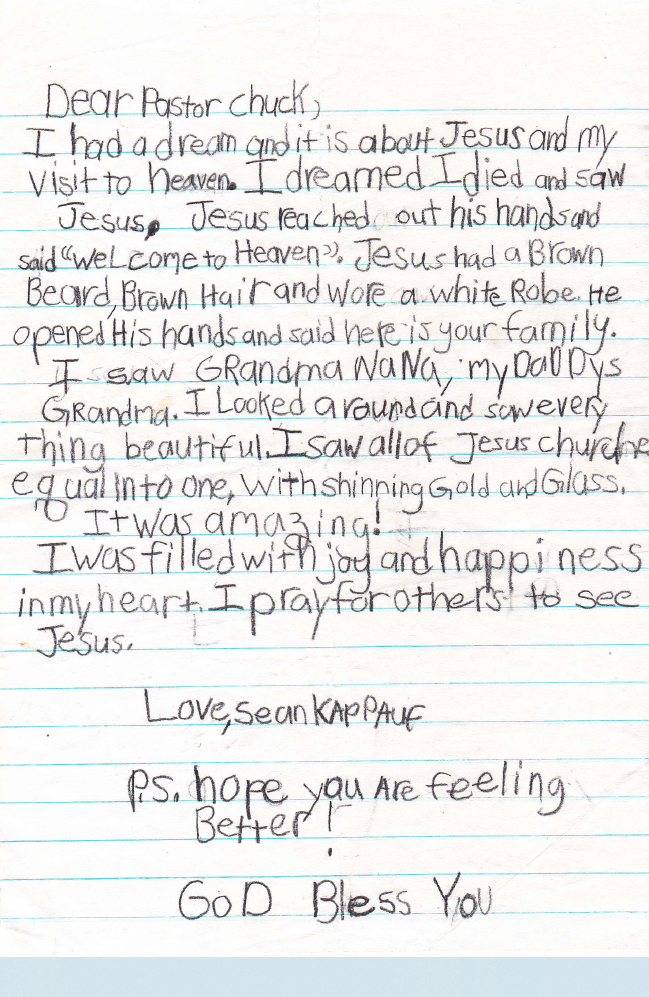
The book of Revelation comes at us more like a dream than a story
– it certainly doesn’t read like history, textbook, or poetry
• so going through it is more like dream interpretation, than a typical, technical Bible study
• Revelation wasn’t written to appeal to our rational mind
◦ it was written to give us an experience of God’s realm
◦ it speaks to us in pictures – like dreams–or nightmares
– chapter four is the first half of a two-part story
• the first will climax in worship of God for his creation
• the second part will climax in worship of Jesus for salvation
Verses 1-2, We are swept up to heaven
Verse 1 begins and ends with, After this (or these things)
– Steve Gregg, says those that interpret Revelation “spiritually” will remind us,
Gregg, “The opening words, ‘After these things,’ do not mean ‘This is what will happen next,’ but rather, ‘This is the vision I saw next.’”
• John is looking around and tells us “behold”
a door standing open in heaven! And the first voice, which I had heard . . . .
(this would be Jesus from chapter 1 and verse 10)
◦ doors hide mysteries – but this door is open – we’re allowed to see behind it
Come up here and I will show you . . .
◦ John is invited to ascend and walk through the door
• Paul tells of a related experience and he teases his readers with it
◦ not that he meant to tease us, but he doesn’t tell us everything
I know a man in Christ who fourteen years ago was caught up to the third heaven—whether in the body or out of the body I do not know, God knows. And I know that this man was caught up into paradise—whether in the body or out of the body I do not know, God knows—and he heard things that cannot be told, which [humans] may not utter” (2 Cor. 12:2-4)
– John doesn’t bother to ask questions, like “Is this in the body or out of the body?”
• he just describes where he went and what he saw
Verse 2, At once I was in the Spirit – what does this mean?
– Jesus made a promise to disciples regarding a new experience in their relationship with God
And I will ask the Father, and he will give you another Helper, to be with you forever, even the Spirit of truth, whom the world cannot receive, because it neither sees him nor knows him. You know him, for he dwells with you and will be in you (Jn. 14:17)
And behold, I am sending the promise of my Father upon you. But stay in Jerusalem until you are clothed with power from on high (Lk. 24:49)
But you will receive power when the Holy Spirit has come upon you (Acts 1:8)
• Paul talks about an inspiration that produces inspired “gifts” (1 Cor. 12)
◦ he gives instructions to Corinthians regarding the proper use of gifts
◦ he explains that:
a person may speak “in the Spirit” or “mysteries in the Spirit” (1 Cor 12:3)
each [one] is given the manifestation of the Spirit for the common good (1 Cor. 12:7)
“tongues” speaks not to men but to God; for no one understands him, but he utters mysteries in the Spirit (1 Cor. 14:2)
• when the Spirit comes over a person it a supernatural effect
do not get drunk with wine . . . but be filled with the Spirit (Ep. 5:18)
– our first vision of heaven is a throne – there’s a reason for that
• this symbol doesn’t produce same effect on us that it would to a person in the first century
◦ but imagine a knock on the door, and when you open it, a sheriff is standing there
◦ or being in a courtroom and the judge calls your name
• what do you feel? typically the authority of the sheriff or judge
◦ they have a power we can’t ignore or fight off
◦ Revelation will keep bringing us back to the “throne” and “thrones”
It is important that a throne is first symbol in heaven we’re given
– the throne is a reality that moves through the entire book — it explains everything
• God’s will is absolute – he rules over heaven and earth
• John gingerly refers to one seated on the throne
– so the first thing, we come to a throne
• and we have to come to terms with this
• I have to ask myself, What rules me?
◦ my inner life–my unconscious motives, desires, fears, etc.?
◦ we have to sort this out – we have to understand our relation to the throne
John maintains his focus on the throne
And he who sat there had the appearance of jasper and carnelian, and around the throne was a rainbow that had the appearance of an emerald. Around the throne were twenty-four thrones, seated on the thrones were twenty-four elders, clothed in white garments, with golden crowns on their heads. Revelation 4:3-4
First, John the appearance of the One sitting on the throne
– unlike his vision in chapter 1, John says nothing about his features
• instead, he sees colors – and his pallet consists of precious gems
◦ the rainbow is probably what gave rise to “halos” in Christian art
– most people dream in color
• what made these colors stand out for John?
◦ it’s possible that they had substance
◦ what is ethereal on earth is solid in heaven
Michael Herbert, who had near death experience said, “Our four-dimensional universe is like a shadow, while heaven has is the reality that casts the shadow.”
• perhaps there was an energy in the colors, and John felt their vibrations
Next, looking around, John saw twenty-four other thrones
– “elders” in Paul’s letters, were (usually older men) who watched over the churches
• have you dreamt about people who have been mentors, care-givers, coaches, or bosses?
◦ we can hear those voices for the rest of our lives
• “white garments” tell us these leaders are good — they have qualified themselves for white garments
◦ “crown” is stephanos – it was not the crown of kings, but like a laurel wreath placed on the heads of winners in athletic competition
◦ their crowns are “golden” because what they do has value
Then the throne again:
From the throne came flashes of lightning, and rumblings and peals of thunder, and before the throne were burning seven torches of fire, which are the seven spirits of God, and before the throne was a sea of glass, like crystal Revelation 5-6
– now throne is making lots of noise – as if it were alive and communicating
(later on we’ll see that the throne can talk: from the throne came a voice (Rev. 19:5)
• in front of the throne, seven torches were burning – seven spirits of God
◦ do your have a favorite number?
◦ seven is a favorite number in Revelation
Edward Edinger says that “The number seven is being shouted at us!”
Philo, refers to seven as “the birthday of the world” (going back to the creation story)
– “a sea of glass” two spaces seemed wild, unpredictable and dangerous to ancient Israel: the and the wilderness
• a of glass like crystal would be awesome – do you think it would reflect colors?
• in dreams the sea, a lake, or pond is our unconscious mind
◦ but here it is transparent, allowing us to look into it and what is underneath
So far its been a magnificent spectacle–now it starts to get weird
And around the throne, on each side of the throne, are four living creatures, full of eyes in front and behind: the first living creature like a lion, the second living creature like and ox, the third living creature with the face of a man, and the fourth living creature like an eagle in flight. And the four living creatures, each of them with six wings, are full of eyes all around and within, and day and night they never cease to say,
“Holy, holy, holy, is the Lord God Almighty,
who was and is and is to come!”
– “live beings,” animal-like, are similar to beings described in Ezekiel’s and Isaiah’s visions
• Ezekiel also saw four living creatures, but they had four wings and each one had four faces
• Isaiah saw “seraphim” – we think angels, but seraphim is an odd name if you look at its root (the angels he saw also had six wings)
I saw the Lord sitting upon a throne, high and lifted up . . . Above him stood the seraphim. Each had six wings: with two they covered his face, and with two he covered his feet, and with two he flew. And one called to another and said:
Holy, holy, holy is the LORD of hosts
the whole earth is full of his glory (Isa. 6:1-3)
◦ the description full of eyes tells us the creatures were all seeing, the visual equivalent of all knowing
◦ nothing escapes their view
◦ but its also that the seeing within indicates enlightenment (Mt. 6:22; Ep. 1:17-18)
– the animals (lion, ox, human, and eagle) may represent “the best in their class”
• again, they are watching everything, but their eyes are especially on God
All that we’ve seen builds to a crescendo
And whenever the living creatures give glory and honor and thanks to him who is seated on the throne, who lives forever and ever, the twenty-four elders fall down before him who is seated on the throne and worship him who lives forever and ever. They cast their crowns before the throne, saying,
Worthy are you, our Lord and God,
to receive glory and honor and power,
for you created all things,
and by your will they existed and were created.” Revelation 4:9-11
Their praise of God is ongoing, and like Isaiah they sing, Holy, holy, holy
– they refer to God as the one who was and is and is to come
• this has the same meaning as the Alpha and Omega
• the Greek alphabet used letters for numerals
◦ the Alpha and Omega contains all number to infinity
◦ some mathematicians and scientists experience “mystical states” moments of insight when they finally come to a breakthrough in an equation or theorem
– the worship that begins with the elders spreads throughout the heavenly vision
• the elders give up their golden crowns (in worship, God is everything)
◦ a verse is added to their previous song – note the word “worthy” — worship is “worthy-ship”
• every time the door to heaven cracks open in scripture, we hear echoes of worship
◦ every thing in heaven and earth owes its existence to God, so praise of him is that wide
Conclusion: I want to emphasize what we’re doing in Revelation
And why I’m treating the vision as a dreamlike experience
I don’t believe it is as important to study and interpret what’s here as it is to experience it
The goal isn’t to get all of this into our heads, but into our hearts
Experience enters a different part of our brains than logic and math
I affects us in ways science and reason cannot
What this means, is a world of possibilities we’ve never discovered
No eye has seen, nor ear has heard,
and no mind has imagined
what God has prepared for those who love him (1 Cor. 2:9 NLB)
Welcome and Prayer: Nancy Lopez
Good morning, RefleXion family! Grace and Peace to you!
I want to remind you that Chuck’s messages can be found in script at the website: reflexionsc.net or through our FaceBook page. It’s always been helpful to me to read the words that I’ve heard on Sunday; I always catch something that Spirit wants to highlight. I have a feeling that this series in Revelation will be especially important to my soul. This phrase: “As for the mystery,” and Chuck’s concluding words from last week are ones that I want to bring as our opening today:
Revelation is difficult because it is full of mysteries.
Those mysteries work the systems that drive our world.
Our lives are also driven by things hidden from us; we do not fully know why we are the way we are or do the things we do.
As for those mysteries, Revelation will help open our eyes as it opens to us the heavens and enable us to deal with what we see.
And then, I am reading a poem as our opening prayer this morning. It is entitled “Every Given Light,” by Jan Richardson. There are some copies on the counter if you’d like to pick one up after the service.
-Every Given Light-
There are days
we think
only so much is given—
a glint,
a gleam,
a light so small
we could carry it
in the palm of
our hand,
just enough
to let us see
the next step,
perhaps,
into the mystery.
There are days
grace comes
but in shadow,
days it gathers itself
into the corners,
days it seems
to turn its gaze
sidelong
as if distracted,
or pondering,
or paused.
Let it be said
this is not
that day.
This is the day
when grace
gives out
its radiance,
declaring itself
to everything
in sight.
This is the day
when every given light
bears forth
like a star,
turning its face
toward us
with the brilliance
that was there
all along,
that it had saved
just for us,
just for the joy
of seeing us
shine.
Jan Richardson
https://www.janrichardson.com/
Morning Talk: chuck smith, jr.
Intro: Chapters 2 and 3 may be the most well known section of Revelation
At least two of our favorite quotations are found here
– what’s the theme of these chapters? Answer: “Church Repairs”
• in chapter 1 Jesus appears in a form not found in the Gospels
• in his right hand he held seven stars–which represented the angels of the seven churches
◦ in scripture, the hand represents power, control, and ownership
– so in these two chapters, Jesus acts as General Contractor has the seven churches in his hand
• he will tell each church what repairs need to be made
If you notice, reading the letters we are still on earth
– we aren’t taken to heaven until chapter 4
• but these letters build a stage on which the drama is played out
• this is a threshold we must cross to get to the heart of Revelation
– it begins with a self-examination – that’s the prerequisite for going forward
Although the seven letters are addressed to seven churches,
All the churches need to hear what is written in every letter
– but going even further, every member of each church needs to hear all seven letters
He who has an ear, let him hear what the Spirit says to the churches
– did you hear the plural, churches?
• the messages are universal – not only in space but also time
• if we wonder what Jesus has to say to American churches today
◦ (and to our “spiritual community”) it’s here in these letters
– “church” isn’t a building, it’s a collection of human persons
• Jesus is the center, and each member is committed to him
◦ Jesus built his church in the world on behalf of the world
◦ the church is supposed to represent him and spread his truth
•but it’s also meant to demonstrate his love and mercy
◦ the world discovers God through his church
– each person can add energy and cohesiveness to the whole
• and any individual can suck the energy out a church and divide it
◦ every person is called to act on their own
◦ churches that don’t allow people to choose and act on their own become cults
• this is where we begin our journey through Revelation
◦ all of us receive it as a personal message in these letters (“You’ve got mail”)
◦ so God’s strange work in us begins here
One more, very important, thought as we proceed
Most letters in the New Testament begins with the authors introducing themselves
Paul, an apostle; James, a servant; Peter, an apostle; etcetera
• the seven letters begin same way; with Jesus introduces himself
◦ after the introduction each one begins with, “The words of . . .”
• but rather than saying, “Jesus, the Christ, the Son of God,”
◦ we find about who he is or what he does
◦ six of the letters draw his description from statements made about him in chapter 1
(letter to Philadelphia uses a crucial Old Testament identification: The words of the holy one, the tre one, who has the key of David . . . .)
– here’s my question for us, and I think it’s important:
• Can we hear each letter as if Jesus addressed it to us?
• can we “take it personally”?
Though the content of the letters differ, they all share the same structure
Every letter:
• begins, “To the angel of,” and then the specific city is designated
◦ “angel” can also be translated “messenger”
Are they not all ministering spirits sent out to serve for the sake of those who are called to inherit salvation? (Heb. 1:14)
• begins its message with, “I know your works”
◦ with exception of Smyrna which reads, “I know your tribulation”
and Pergamum, “I know where you dwell, where Satan’s throne is”
◦ Jesus knows – our challenges, hardships, service, problems, and so on
• either contains a contrast (e.g., “But I have this against you”)or does not
◦ two of the letters don’t contain a contrast, because those church are all good
◦ two others letters lack the contrast, because those churches all bad
• in the middle section we find is Jesus’ specific message
◦ what’s right – what’s wrong – what to do about it
• makes the same two statements at the end
1. “He who has an ear, let him hear what the Spirit says to the churches”
◦ this is a capacity that we have to develop (see Mk. 8:18, “Having eyes do you not see?”)
2. “The one who conquers . . .” and after that a reward is promised
I’m going to paraphrase each letter (because it would take too long to explain everything in them)
Dear church in Ephesus, I know your hard work and that you have patiently endured it. It is wonderful that you don’t put up with evil people. In fact, you have looked into and fact-checked self-proclaimed apostles and exposed the ones who are imposters. Your endurance and patience are a good combination. I’m also pleased that you continue to hang in there for my sake. In all of this, you have not grown weary.
HOWEVER, not growing weary doesn’t mean that you’re zealous. Your heart is no longer in what you do, because you’ve given up the love you had at first. You must remember, because that’s what lovers do. Remember where you were before you fell. Go back to the beginning of our early romance and do those things again. If you don’t, I will withdraw my light from you and you will no longer be my church.
Then there is another thing you do that pleases me; you don’t put up with those Nicolaitans and their false teaching.
Develop your ability to hear what the Spirt is telling you. I will give to any one among you who wins this battle the privilege of eating from the “tree of life.” Doing that was forbidden before, but is possible now.
Dear church in Smyrna, I know your hardship and poverty, but the truth is, you really are rich. I know you have been slandered by people who claim to be legit, but they’re just the opposite, doing the devil’s work. It’s going to get worse for you, but don’t be afraid, not even when the devil throws some of you into prison. (You don’t have to take this literally, because there are different kinds of imprisonment.) There’s a purpose for this and it will be limited to a few days. Stay true, even if you face death, and I will reward you with a crown of victory .
Listen to the Spirit, and the one who wins this battle will escape the second death. (What that is will be explained to you later.)
Dear church in Pergamum, I know where you live, and that it’s a rough place, because Satan rules there. In spite of that, you’ve held onto my name and not turned away from your faith in me, even at the risk of martyrdom.
HOWEVER, there are a few things that are not right in your church. First, you tolerate the false teaching of Balaam, which in his case was compromise and tripping up true believers so that they did wrong. Secondly, you tolerate the teaching of the Nicolaitans.
So what you have to do is change, otherwise you will be fighting against Me–and you will lose.
Listen to the Spirit and the one who wins this battle will enjoy the “hidden manna”–the bread of life. And you will be given a white stone with you name engraved on it–a secret name.
Dear church in Thyatira, I know you are the perfect model of a Christian church or Christian individual. In love, faith, service, and patient endurance, your are doing even better now than at first.
HOWEVER, you tolerate that wicked Jezebel, whose very name is associated with evil. She acts like a queen and claims to be a prophet. Her message is seductive. She leads people into the adultery of embracing other gods. I gave her the chance to turn, but she hasn’t. Those among you who choose to follow her cult will be tossed onto a sickbed and into great tribulation, until your illness proves fatal. This is a lesson for all the churches: I search the mind and heart.
Each of you will be rewarded or punished according to your works. From those who have not bought into the Jezebel cult, I don’t require anything else from you, except to hang onto what you have, all the way until I return.
The one who wins this battle will be given authority and be able to authorize others to exercise it, even as I have received authority from the Father (as described in Psalm 2). I will also give them the morning star. Listen to the Spirit.
Dear church in Sardis, I know that you are a church with quite a reputation. People say, “That church is alive!” But you aren’t, you’re dead. WAKE UP! You have some life left in you, fan it into a flame, because it’s smoldering and about to go out. Remember what has been given to you and what you’ve been taught. Hang onto it and turn back to it. If not, I’ll come to you like a thief, when you’re not expecting me.
Nevertheless, there are a few of you whose clothes are still clean and have not been stained or disgraced. They will walk with me in white.
The one who wins this battle will be dressed in white; an honor not given to everyone. And that person’s name will remain forever in the book of life. I will acknowledge them before my Father as they have acknowledged Me.
Listen to the Spirit.
Dear church in Philadelphia, I know how well have done, and for that reason I’ve opened a door for you that no one can shut. I also know that even though you’re not a powerful church, you haven’t lost your grip on my word or who I am.
Look, here is what I’m going to do. I am going to take those posers who belong to Satan while claiming to be the true church, and bring them to you and cause them to show you respect. They are going to learn the truth, that I have loved you.
Because you have kept my word of patience and stamina, I’m going to protect you from the terrible ordeal that for a time will trouble the world and everyone in it.
I will come to you soon. Hang in there, doing what you’ve been doing, so that no one takes the victory crown that you’ve won. The one who wins this battle, will be made a pillar in the temple of my God. You will never have to leave it. I will sign you with the name of my God, the name of the city of my God, and the new Jerusalem from heaven, and my own new name.
Listen to the Spirit.
Dear church in Laodicea, I know what you’re about. First, you are tepid, neither hot nor cold, and unpalatable. In keeping with that metaphor, I’m going to spit you out. Secondly, you say you’re rich and prosperous –a materialistic boast. From my point of view, you are wretched, pitiable, poor, blind and naked. I advise you to get the true wealth from me, which can not be had by money. My gold has real value, and has already been refined, and is therefore pure. Do this and you will be rich. With the blessing of my wealth, you will be able to have white clothing to cover your naked bodies; and eye salve to heal your blindness.
Now pay attention, those that I love, I also discipline. I am disciplining you now so that you will be passionate and turn back to me. Look, I am right here at your door knocking. Anyone inside may hear, and anyone can open the door. If you do, I will enter and share a meal with you.
The one who wins this battle, will be invited to my table and my throne. I also won my battle for you, and sit at my Father’s throne.
Listen to the Spirit.
Conclusion: Several words I would have liked to elaborate on
Pillar – door – thief – key – and white stone
– it is good for us to feel the depth of these metaphors
Now we have learned the purpose of Revelation
That it is meant to work in deep regions of our hearts and minds
That it is meant to prepare us for the new creation
And it does this by re-creating us
So having been here today,
and going over the messages of Jesus to his church,
something has entered us that is meant to change us
To make us more like the people we are supposed to be
Namely, agents of change in a world that is broken
A world than needs love and peace and healing
A world that needs God’s touch through God’s church
 Daily Meditations From the Scriptures